


Business Immigration Pathways in 2026: Strategic Advising for Entrepreneur Clients (PNPs, C11/ICT & SUV Backlog Strategy)
Business Immigration Pathways in 2026: Strategic Advising for Entrepreneur Clients (PNPs, C11/ICT & SUV Backlog Strategy)
Updated 03-Mar-2026 • 8 min read
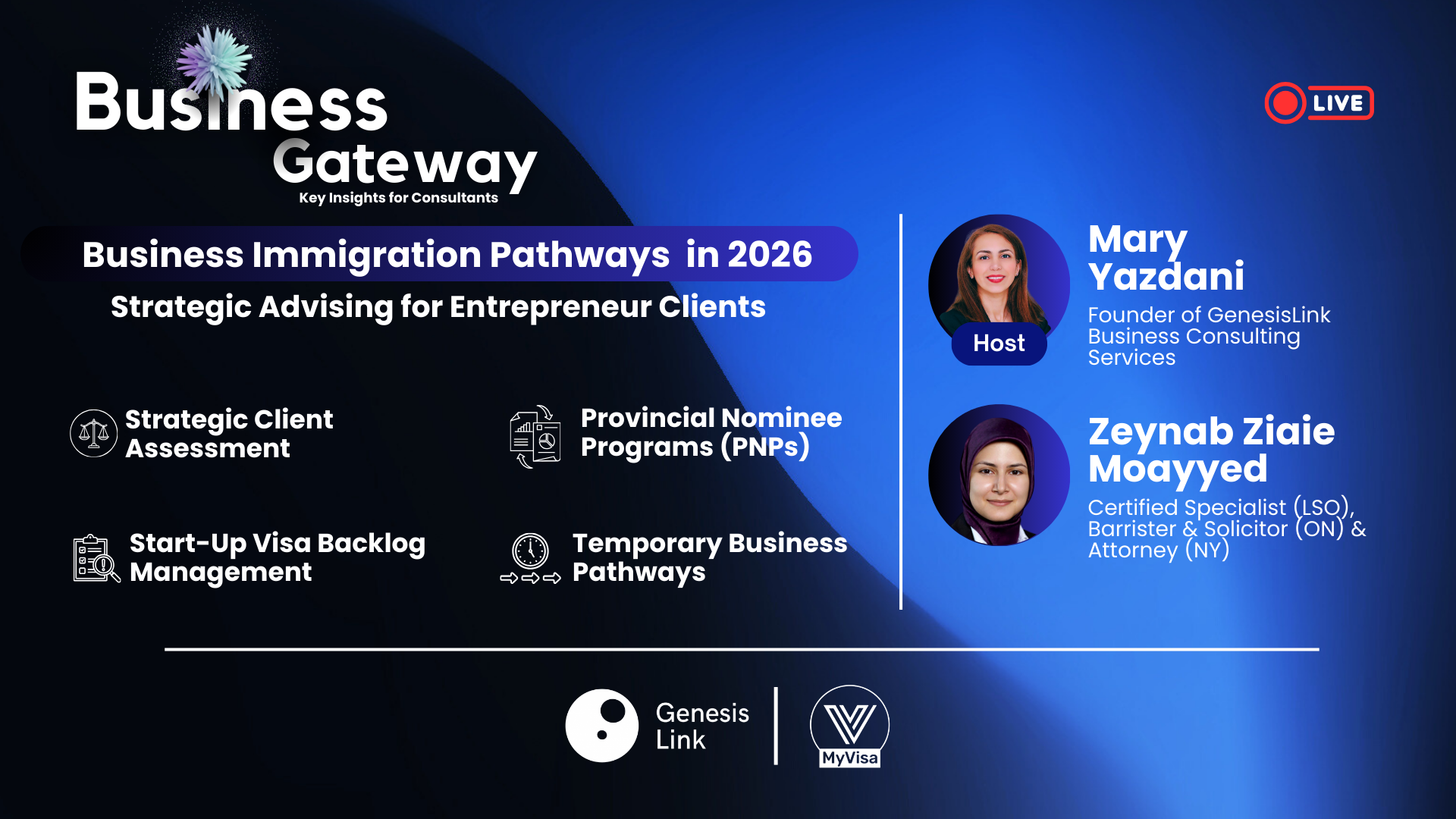
In this Business Gateway webinar hosted by Mary Yazdani (GenesisLink) with guest speaker Zeynab Ziaie Moayyed (Certified Specialist – LSO | Barrister & Solicitor (ON) & Attorney (NY)), the discussion focused on how immigration professionals can confidently advise entrepreneur clients in 2026—especially amid shifting federal signals, uneven provincial draw activity, and increased scrutiny on business viability and compliance.
Rather than presenting “one pathway,” the session emphasized a strategy-first approach: assessing each client’s goals, timeline, risk tolerance, and operational readiness—then structuring a path that aligns temporary and permanent options in a clean, credible way.
The 2026 Reality: Advising Requires Structure, Not Guesswork
Mary framed the session around one core challenge: entrepreneur files don’t fail only because of eligibility—they fail when the strategy is unclear, evidence is inconsistent, or the business case lacks real operational logic.
The webinar positioned business immigration as a sequenced plan:
- Build the right pathway logic (TR vs PR)
- Align the business model and evidence with the chosen route
- Reduce risk through compliance-ready documentation and operational milestones
Strategic Client Assessment: TR vs PR Mindset
A key takeaway was the importance of separating two common client needs:
- Temporary entry to operate (TR strategy)
- Long-term PR planning (PR strategy)
Zeynab highlighted that stronger files show:
- A clear purpose and value narrative
- Operational feasibility (what will be executed, by whom, and when)
- Documentation consistency across the business plan, ownership, and financials
The goal is to avoid “mixed messages” that can create credibility gaps during officer review.
Temporary Pathways: Positioning C11, ICT, and Owner-Operator
The session explored temporary strategies often used by entrepreneurs and scaling companies, focusing on how to strengthen credibility and reduce refusal risk.
Key themes included:
- Choosing the right option based on corporate structure and real operational need
- Showing execution capacity (not just intent)
- Presenting business viability with realistic assumptions and documentation discipline
Rather than “selling a work permit,” the webinar emphasized presenting a coherent business and compliance story that stands up to scrutiny.
Provincial Nominee Programs: Entrepreneur Streams in 2026
A major section focused on PNP entrepreneur pathways and how to position clients based on:
- Province-specific requirements (investment, net worth, job creation, exploratory visits)
- Location fit and operational feasibility
- The client’s ability to execute locally and document progress
The discussion reinforced that PNP success often comes down to realistic operational planning and province-aligned execution—not generic business plans.
Start-Up Visa Backlog: Managing Existing Files Strategically
For clients already in the SUV pipeline, the webinar addressed how to manage long timelines with a proactive approach.
The recommended posture:
- Maintain an organized “single source of truth” evidence set
- Keep business progress and documentation current (traction, contracts, updates)
- Prepare for short-notice IRCC requests with compliance-ready records
The overall message: backlog management is not passive waiting—it is disciplined evidence continuity.
Compliance Positioning: The Quiet Advantage in Strong Files
Across all pathways, Zeynab emphasized that better outcomes often come from:
- Clear, consistent documentation
- Clean ownership and role definitions
- Strong financial clarity (sources of funds + business operating logic)
- Practical operational milestones that match the pathway
This approach strengthens credibility and reduces avoidable friction in officer review.
Key Takeaways for Immigration Professionals
- Use a structured assessment framework before recommending a pathway
- Separate TR and PR logic—then connect them with a coherent plan
- Strengthen temporary strategies with business viability and documentation discipline
- Treat PNP entrepreneur streams as execution-driven programs (not “forms-driven”)
- Manage SUV backlog files through evidence continuity and proactive readiness
If you’d like, I can also:
- match this exactly to your website’s webinar card style (same headings length + tone)
- generate a shorter “content” version (for a compact page layout)
- create the matching excerpt + key bullet highlights for the webinar grid