


ESDC Updates TFWP Wage Thresholds Effective July 17, 2026: What Business Immigration Advisors Need to Know
Effective July 17, 2026, the Employment and Social Development Canada (ESDC) updated the hourly wage thresholds that determine whether a position qualifies as high-wage or low-wage under the…
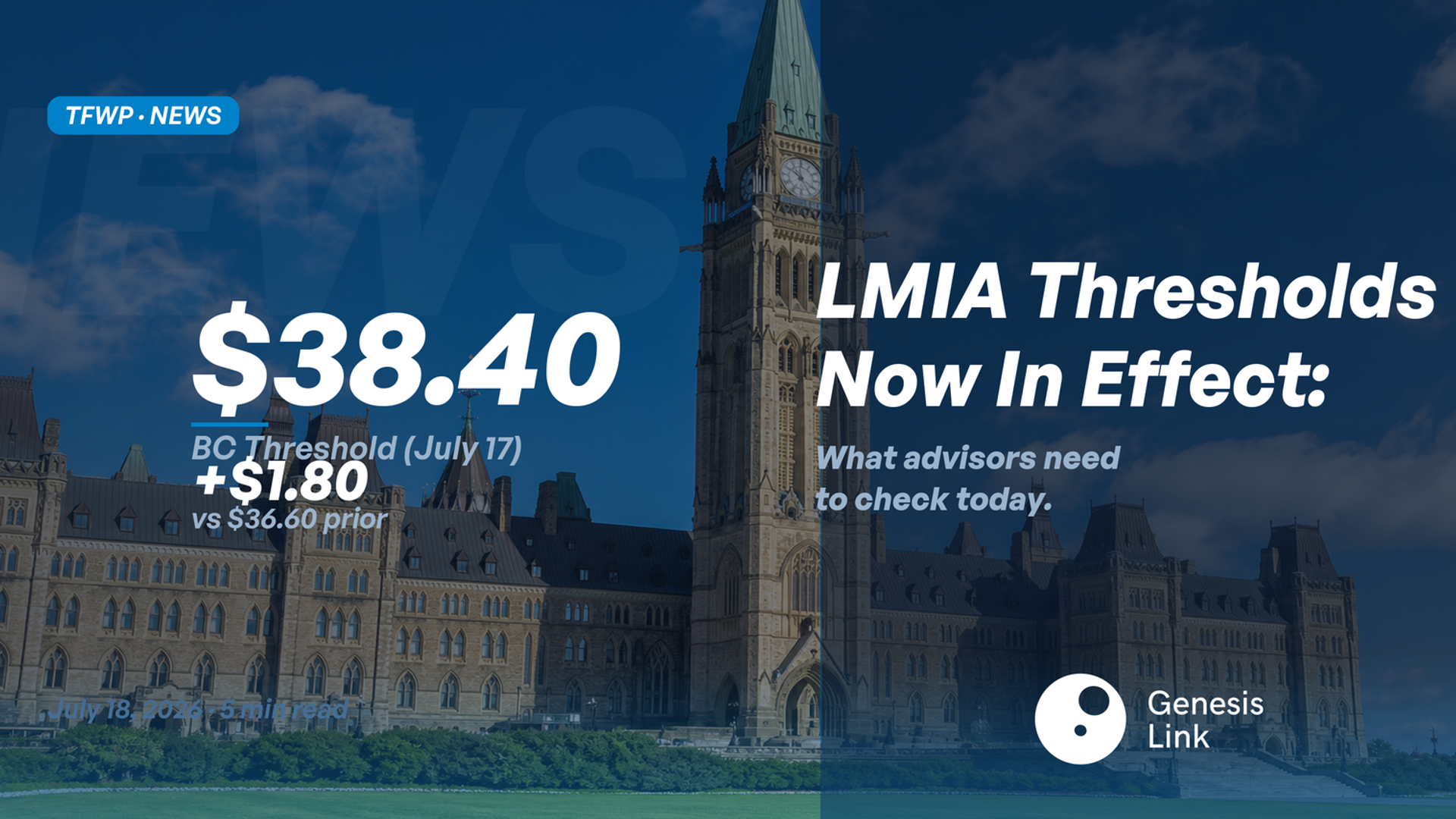
Effective July 17, 2026, the Employment and Social Development Canada (ESDC) updated the hourly wage thresholds that determine whether a position qualifies as high-wage or low-wage under the Temporary Foreign Worker Program (TFWP). For business immigration advisors with active Labour Market Impact Assessment (LMIA) files, this update requires immediate attention.
This article outlines exactly what changed, which provinces saw the largest shifts, how the freeze zone rules interact with the new thresholds, and what advisors should verify before their next file submission.
What Changed and Why It Matters
ESDC sets TFWP wage thresholds annually based on median hourly wages from Statistics Canada's Labour Force Survey. The thresholds define the boundary between the high-wage and low-wage streams. A position offered at or above the provincial median hourly wage qualifies as high-wage; below it, the position falls into the low-wage stream, which carries additional restrictions and, in certain Census Metropolitan Areas (CMAs), a full processing freeze.
The July 17, 2026 update reflects revised median wage data. Advisors who processed LMIA applications before this date. Or who are preparing submissions based on wage data from six months ago. May find that positions previously classified as high-wage no longer meet the updated threshold.
Updated Wage Thresholds by Province (July 17, 2026)
Every jurisdiction saw an increase. The largest absolute shift occurred in Nunavut (+$3.00/hr), while British Columbia (+$1.80/hr) and Alberta (+$1.50/hr) saw the most material changes for markets where business immigration files are concentrated.
The Freeze Zone Interaction: What Advisors Must Check
The wage threshold update is particularly consequential for files located in CMAs subject to the low-wage LMIA moratorium. As of July 2026, approximately 30 CMAs remain in the freeze zone. Meaning ESDC will not process low-wage LMIA applications in those areas regardless of employer circumstances.
The four largest affected markets are:
- Toronto CMA. Unemployment rate 7.9%
- Vancouver CMA. Unemployment rate 6.5%
- Calgary CMA. Unemployment rate 7.1%
- Edmonton CMA. Unemployment rate 7.0%
For a position located in any of these CMAs: if the offered wage was above the prior threshold but falls below the new July 17 threshold, the position has now been reclassified as low-wage. Under the moratorium, ESDC will not process the LMIA until the employer adjusts the offered wage above the new threshold.
This is not a minor administrative adjustment. For files already submitted or near-ready for submission, the reclassification can trigger a formal refusal or a request for additional employer documentation at a wage level the employer may not have budgeted for.
Practitioner Action Checklist
Business immigration advisors should complete the following before submitting any LMIA application dated on or after July 17, 2026:
- Verify the CMA classification. Confirm whether the position's work location falls within a freeze zone CMA. The ESDC CMA list was also updated effective July 17. Do not rely on lists downloaded before that date.
- Cross-reference the offered wage against the new provincial threshold. Use the July 17, 2026 figures above. If the offered wage is between the old and new threshold, the position has been reclassified.
- Review files in progress. If a file was submitted before July 17 and is still in processing, the offered wage at submission controls the classification. However, if ESDC requests updated documentation, the current threshold applies.
- Communicate with employer clients promptly. If a reclassification affects a file, advisors should notify the employer and assess whether a wage adjustment is operationally feasible before proceeding.
- Update internal wage reference sheets. Any internal checklists, intake forms, or employer-facing documentation referencing provincial wage thresholds should be updated to reflect the July 17, 2026 figures.
What This Means for Business Immigration Strategy
The annual threshold update is a predictable event, but the size of this year's increases. Particularly in BC and Quebec. Reflects broader labour market tightening that shows no sign of reversing in the near term. Advisors building LMIA-dependent strategies for corporate immigration clients should factor in that wage thresholds are likely to increase again in 2027, potentially reclassifying additional positions.
For C11 and ICT pathways, where LMIA is not required, this update has no direct impact. However, advisors who advise clients on both pathways should be prepared to discuss the TFWP threshold changes with employers who may be evaluating whether to switch from an LMIA-based strategy to a LMIA-exempt federal pathway.
GenesisLink supports business immigration advisors and law firms on the business documentation and financial modelling components of complex immigration files. If your team is navigating a file affected by the July 17 threshold changes, book a consultation to review your options.
Recent News

 October 16, 2026

More on Policy updates & news
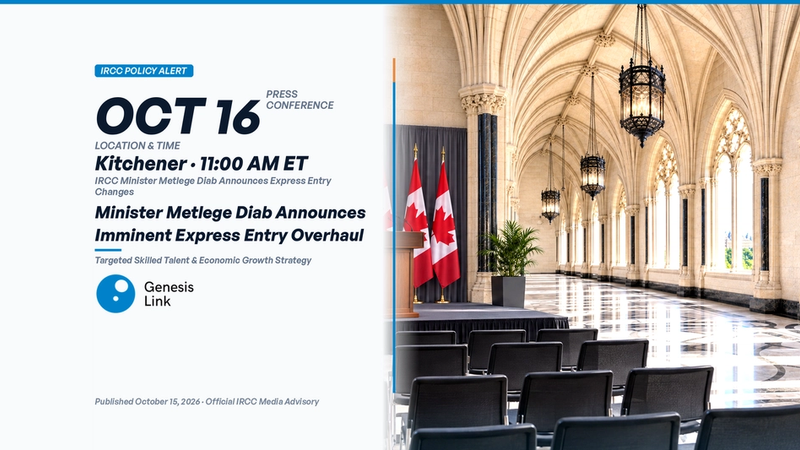 NewsIRCC Announces Imminent Express Entry Changes: Minister Briefing Scheduled for October 16
 NewsExpress Entry CEC Draw 439 Confirmed: 2,000 ITAs at CRS 521-1 September 2026
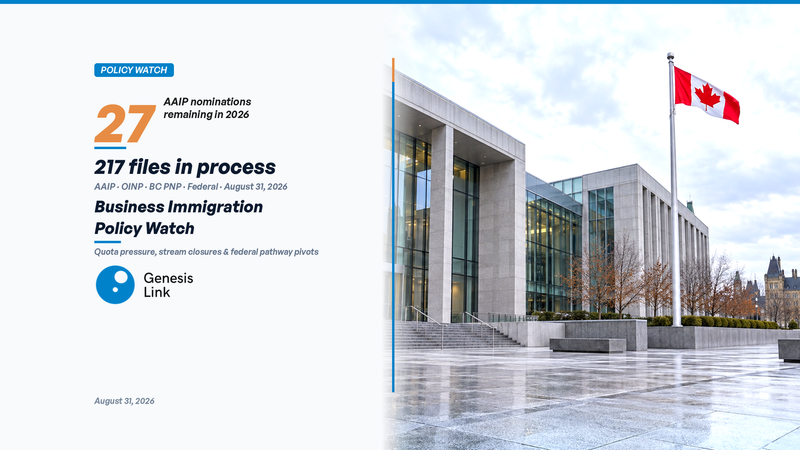 NewsBusiness Immigration Policy Watch, August 31, 2026
 BlogBusiness Immigration File Review Insights August 2026: 3 Practitioner Patterns in C11, ICT, and BC PNP Applications
 BlogCanada Business Immigration News August 2026: Provincial Stream Allocations & Federal Pathway Calibration
Discussion
Be the first to comment.
Add a comment