


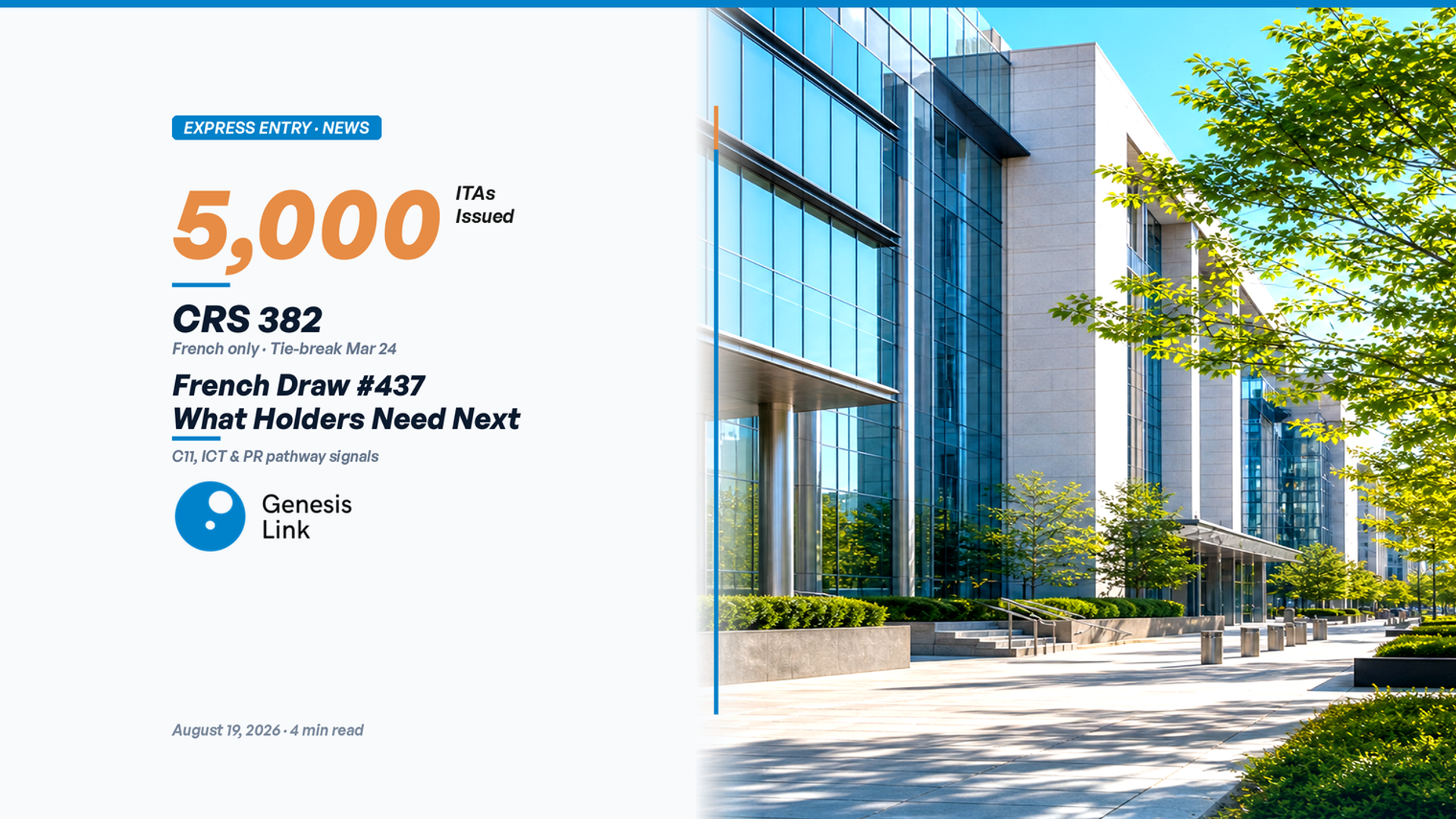
Express Entry French Draw #437, August 19, 2026: 5,000 ITAs at CRS 382
IRCC French-language Express Entry Round #437 on August 19, 2026 invited 5,000 candidates at CRS 382. What C11, ICT, and PNP files should review next.
Last reviewed: 19 August 2026. Confirm round details on the official IRCC rounds-of-invitations page before you brief a client file. CRS cut-offs change with each draw.
Immigration, Refugees and Citizenship Canada (IRCC) ran a French-language proficiency Express Entry round on 19 August 2026 (Round #437). The round issued 5,000 invitations to apply (ITAs). The minimum Comprehensive Ranking System (CRS) score was 382. The tie-breaking rule was 24 March 2026 at 18:42:10 UTC.
This French-language round followed the 18 August 2026 Canadian Experience Class (CEC) draw (#436), which invited 1,000 candidates at a CRS floor of 523. The gap between those two floors is the practical story for advisors: French-category selection is still moving large volumes at a much lower CRS than recent CEC rounds.
Key details: Round #437
- Date: 19 August 2026
- Category: French-language proficiency (2026 Version 2)
- ITAs: 5,000
- Minimum CRS: 382
- Tie-break: 24 March 2026, 18:42:10 UTC
Always verify the live IRCC table for the authoritative line items. Do not treat any secondary summary as permanent truth after a later round posts.
Why this matters for C11, ICT, and PNP files
Many C11 owner-operator and ICT executive profiles still land below recent CEC cut-offs when age, single-language CLB, or Canadian education points are thin. A French-category floor at 382 changes the planning conversation for holders who can reach the French-language eligibility bar for category selection.
French proficiency does not replace a defensible Canadian business case. It can open a federal invitation path that does not wait on provincial entrepreneur capacity. PNP entrepreneur streams remain capacity-bound in H2 2026 in several provinces; French-category Express Entry is a separate federal lane when the candidate qualifies.
What our files show
In active business-immigration packages we support with RCICs and counsel, founders often treat French as optional soft skill work. At a 382 French floor next to a 523 CEC floor, NCLC planning becomes a file-timeline decision, not a nice-to-have language goal. The business plan still has to carry Canadian benefit, active management, and credible operations. Language points only help if the rest of the package is submission-ready when an ITA lands.
Advisor actions this week
- Map any C11/ICT holder near PR timing against French-category eligibility and a realistic NCLC plan.
- Keep CEC evidence current anyway. French rounds do not cancel CEC or PNP clocks.
- For ITA recipients in this round, start the 60-day e-APR clock immediately: corporate tax, NOC-aligned duties, and proof of funds or business continuity where relevant.
- Do not freeze PNP entrepreneur work solely because a French round ran. Nomination capacity and provincial evidence still bind H2 strategy.
FAQ
Is CRS 382 a permanent French cut-off?
No. Each round sets its own minimum. Use the IRCC rounds page for the current figure after every draw.
Does a French ITA replace C11 or ICT business documentation?
No. Work-permit and PR packages still need pathway-specific evidence. French selection changes invitation odds for eligible pool candidates; it does not rewrite IRCC’s business-case tests on C11 or ICT.
Should PNP entrepreneur clients pause files?
Usually no. Treat French-category EE as a parallel federal option for candidates who qualify, not as a substitute for provincial nomination strategy where the client’s plan is province-led.
Author: Sajad Bahramian, Marketing and Sales Lead, GenesisLink. GenesisLink is a business consulting firm; we do not provide immigration legal advice. Confirm all draw figures on canada.ca before you brief a client or file.
Discussion
Be the first to comment.
Add a comment