


New Brunswick Eases Atlantic Immigration Program Restrictions: Endorsement Intake Reopened Across Most NOCs
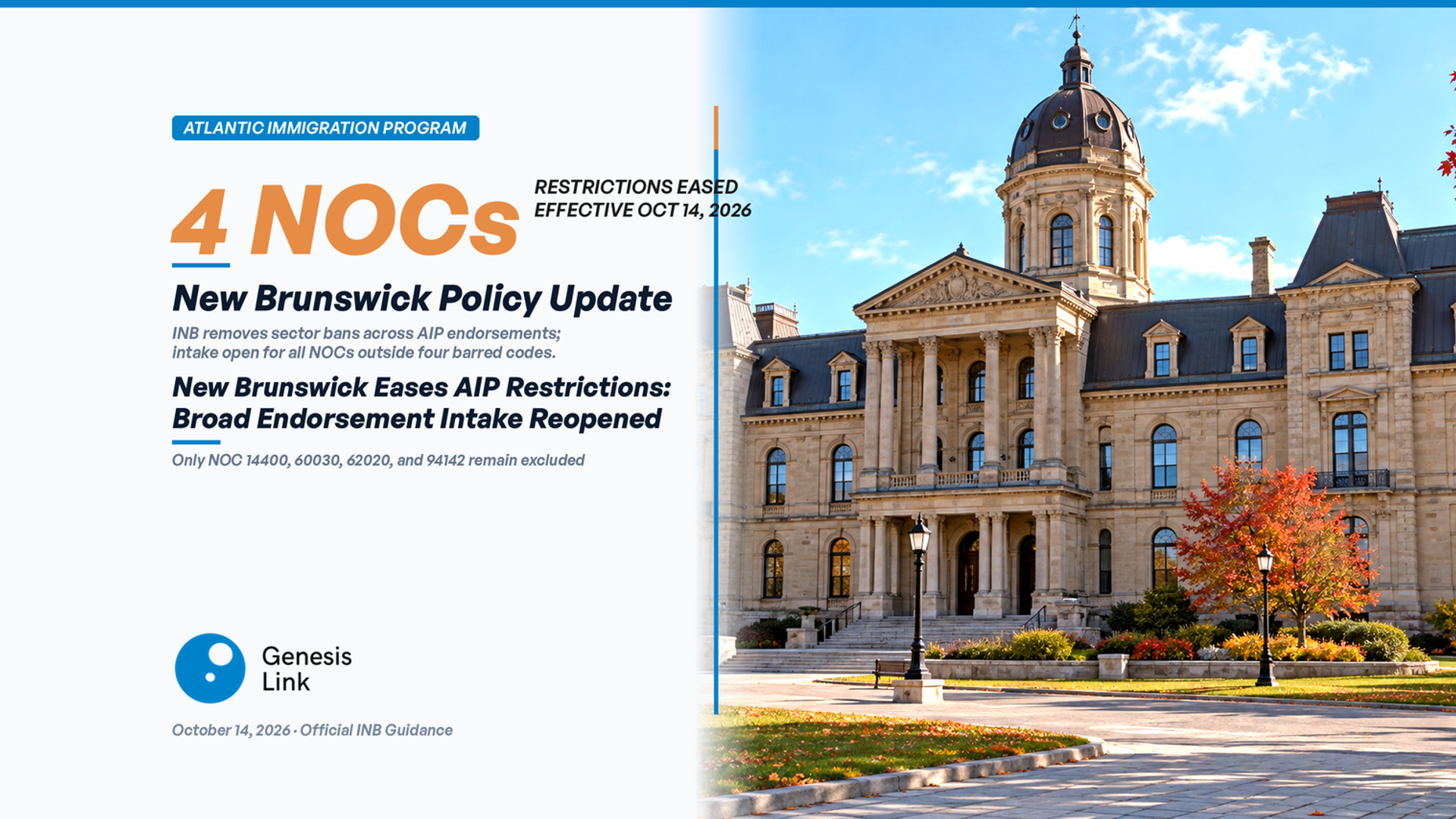
Effective October 14, 2026, Immigration New Brunswick has removed extensive occupation restrictions under the Atlantic Immigration Program, reopening candidate endorsements for all occupations outside four barred codes.
60-Second Executive Summary for Immigration Advisors
- What Changed: Effective October 14, 2026, Immigration New Brunswick (INB) removed broad candidate endorsement occupation restrictions under the Atlantic Immigration Program (AIP). Endorsement applications may now be submitted for all eligible TEER 0, 1, 2, 3, and 4 occupations outside four specific exclusions.
- The 4 Excluded Occupations: Only NOC 14400 (Shippers and receivers), NOC 60030 (Restaurant and food service managers), NOC 62020 (Food service supervisors), and NOC 94142 (Fish and seafood plant workers) remain barred from endorsement.
- Offshore vs. Inland Eligibility: Inland candidates already working in New Brunswick gain immediate access across diverse industries. Endorsements for foreign nationals residing outside of Canada remain strictly restricted to GNB-led recruitment initiatives in health care, education, and construction.
- Employer Intake Context: New employer designation applications under AIP remain paused for the remainder of 2026 (effective since September 14, 2026). This policy easing applies specifically to currently designated employers submitting candidate endorsements.
On October 14, 2026, Immigration New Brunswick (INB) published a significant operational update to its Atlantic Immigration Program (AIP) candidate endorsement guidelines. The province has officially dismantled extensive sector-wide restrictions that previously constrained candidate endorsements, reopening intake across the majority of the National Occupational Classification (NOC) matrix for candidates physically residing and employed within the province.
For immigration practitioners, designated Atlantic employers, and corporate human resources teams navigating tight provincial allocations, this update marks an immediate operational pivot. Below is our practitioner breakdown of the regulatory changes, employer qualification requirements, and strategic file considerations.
Which Occupations Remain Strictly Ineligible Under New Brunswick AIP?
While the lifting of restrictions opens widespread doors for technical, administrative, logistics coordination, and skilled trades roles, Immigration New Brunswick maintained a narrow negative list of four excluded occupations:
- NOC 14400: Shippers and receivers
- NOC 60030: Restaurant and food service managers
- NOC 62020: Food service supervisors
- NOC 94142: Fish and seafood plant workers
In addition, all TEER 5 occupations remain statutorily excluded under the Atlantic Immigration Program framework in New Brunswick. Employers in food service and seafood processing who previously relied heavily on provincial endorsement mechanisms must note that supervisor and managerial roles in hospitality continue to face restricted pathways provincially.
Who Qualifies Under the October 14 Policy Shift?
The primary beneficiaries of this regulatory reopening are inland foreign nationals currently residing in New Brunswick and holding valid temporary work authorization with an active, designated employer. Specifically:
- Professional and Corporate Roles: Positions in business services, corporate administration, marketing, accounting coordination, logistics management, and information technology that were previously paused under sector-wide freezes can now proceed to candidate endorsement.
- Skilled Trades and Manufacturing: Industrial mechanics, fabricators, transportation maintenance specialists, and construction trades outside the previously narrow priority bands now qualify directly for endorsement.
- Designated Employers: Existing employers who obtained AIP designation prior to the September 14, 2026 intake freeze can now utilize their designation across their broader staffing hierarchy.
What Our Files Show: Inland Endorsement Dynamics
Across client operations and partner RCIC advisory files, candidate endorsement applications are under heightened scrutiny regarding economic retention. Meeting the baseline NOC qualification does not guarantee nomination; INB actively prioritizes candidates with proven residential attachment, established payroll history within New Brunswick, and employment stability. Applications demonstrating clear compensation alignment with regional prevailing wages experience significantly higher approval velocities.
What Selection Criteria Will Immigration New Brunswick Prioritize?
INB explicitly cautioned in its official release that meeting baseline eligibility does not guarantee endorsement. With provincial nomination allocations capped across Canada for 2026, demand continues to outpace available endorsement certificates. INB has established clear prioritization factors:
- Duration of Employment in New Brunswick: Candidates who have completed substantial continuous service with their endorsing employer receive higher priority scoring.
- Demonstration of Economic Establishment: Established community integration, spousal employment, home ownership or long-term lease commitments, and language proficiency above baseline minimums.
- Priority Sectors: While open across TEER 0-4, files in healthcare, education, and construction continue to enjoy expedited processing bands.
Alternative Pathways for Candidates Facing Work Permit Expirations
Immigration New Brunswick explicitly highlighted that individual processing times cannot be guaranteed prior to work permit expiry. For candidates currently holding expiring Post-Graduation Work Permits (PGWPs) or employer-specific authorizations, INB formally directs employers and counsel to maintain status via federal channels:
- Temporary Foreign Worker Program (TFWP) / LMIA: Dual-intent or regular Labour Market Impact Assessments to support work permit extensions while endorsement is pending.
- Intra-Company Transfers (ICT - C12) and Significant Benefit (C11): For entrepreneurial operators or multinational enterprises expanding operational divisions into Atlantic Canada, owner-operator and managerial exemptions under the International Mobility Program provide independent federal bridges exempt from provincial allocation limits.
Practitioner Next Steps
Immigration advisors and corporate employers with pending candidate files in New Brunswick should take three immediate actions:
- Audit Existing Workforce Profiles: Identify staff members in TEER 0, 1, 2, 3, and 4 roles who were previously shelved due to earlier sector restrictions and verify that their employer holds active AIP designation.
- Verify Work Permit Validity Buffers: Ensure candidates have at least 4 to 6 months of valid temporary work authorization remaining, or initiate concurrent LMIA/federal work permit extension strategies.
- Prepare Comprehensive Economic Attachment Portfolios: Strengthen endorsement filings with documented evidence of regional settlement, utility history, local community involvement, and long-term organizational viability.
Official Primary Source: Government of New Brunswick, Department of Post-Secondary Education, Training and Labour (PETL), Immigration New Brunswick Important Notices (Published October 14, 2026, gnb.ca).
Discussion
Be the first to comment.
Add a comment