

A practitioner-grade guide to structuring ICT work permit business plans, physical premises evidence, corporate qualifying relationships, and financial documentation under C61, C62, and C63 streams.
Read More9 items — blogs and news sharing this topic, most recent first.

A practitioner-grade guide to structuring ICT work permit business plans, physical premises evidence, corporate qualifying relationships, and financial documentation under C61, C62, and C63 streams.
Read More
A practitioner guide for Canadian RCICs and immigration counsel on structuring Intra-Company Transferee (ICT) files for corporate groups originating in the UAE, Saudi Arabia, and the broader Gulf region.
Read More
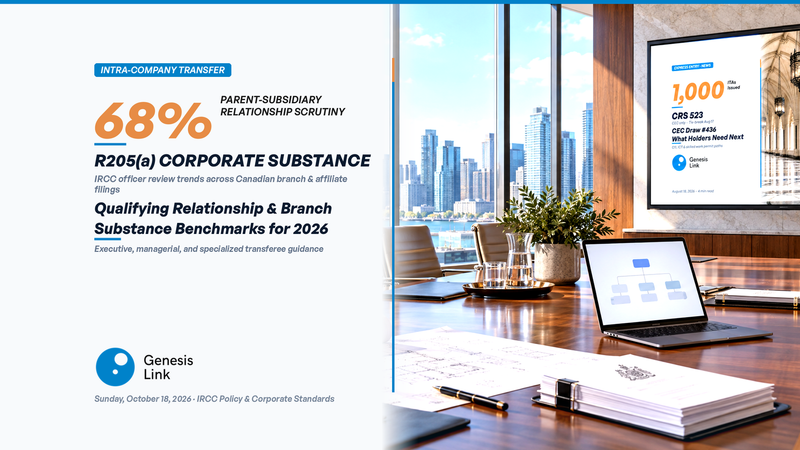
A practitioner breakdown of IRCC adjudication standards for Intra-Company Transfers (R205(a) C61/C62/C63) in 2026, focusing on foreign parent-subsidiary substance, continuous employment proof, and Canadian office capitalization.
Read More
A practitioner's guide to IRPR R205(b) intra-company transfer Canada work permits in 2026. Covers executive C61, manager C62, specialized knowledge C63, and start-up branch evidence.
Read More
ICT vs LMIA Canada 2026: a practitioner's decision framework based on 19 ICT files reviewed. In 6 files that hit officer delays, the gap was always qualifying relationship or category fit, never employment history. Here's how to choose the right route.
Read More
Master ICT work permit business plan requirements for Canada in 2026. Learn officer standards for C61, C62, and C63 codes with file data from 300+ cases.
Read More
Most ICT work permit files describe specialized knowledge through job titles and years of experience. IRCC officers evaluate something entirely different. Here is the dual-track framework behind the standard, where files break down, and what a defensible specialized knowledge package actually looks like.
Read More
The word ‘specialized’ carries precise legal weight in ICT work permit applications. Most files fail not because the applicant lacks credentials, but because the documentation describes expertise rather than proprietary, company-specific knowledge. Here is what officers actually evaluate — and how to build documentation that meets the standard.
Read More
The qualifying relationship is one of the two foundational pillars of any ICT application. When the corporate relationship between the foreign and Canadian entity cannot survive officer scrutiny, the entire file is at risk — regardless of how well-documented the applicant's role is. Here is what IRCC officers actually examine, and how to build a qualifying relationship package that holds up.
Read More