



- GenesisLink
 June 17, 2026
 Business Immigration
Foreign nationals have more structured business immigration pathways in Canada in 2026 than ever before. This guide covers the C11 work permit, ICT, and PNP entrepreneur streams — including thresholds, timelines, and the business documentation standard that determines approval.
Foreign nationals looking to build a business in Canada have more structured pathways available in 2026 than at any point in recent history. The federal government has streamlined its approach around three core streams — the C11 Significant Benefit Work Permit, the Intra-Company Transfer (ICT), and provincial entrepreneur programs — each designed for a different stage of business development and investor profile. This guide breaks down each pathway, the business requirements that determine eligibility, and the strategic positioning decisions that determine whether a file succeeds or stalls.
What "Business Immigration" Actually Means for Non-Residents
For non-residents, business immigration to Canada follows a different logic than employment-based immigration. Rather than securing a job offer or meeting a points-based threshold, business immigration requires demonstrating that your business activity — or intended business activity — generates measurable benefit to Canada.
That benefit is evaluated at the business level, not the personal level. IRCC officers assess the viability of the enterprise, the credibility of the financial model, the job creation impact, and the applicant's operational role. Immigration eligibility follows business credibility — not the other way around.
This is why business immigration files require a different category of documentation than standard work permits or permanent residence applications.
The Three Active Federal Pathways in 2026
The Canada Start-Up Visa (SUV) program was paused on January 1, 2026, removing one major entry point. The pathways that remain active for non-residents are:
1. C11 Significant Benefit Work Permit
The C11 work permit is the most flexible federal pathway for foreign entrepreneurs. It does not require a job offer from a Canadian employer. Instead, it requires the applicant to demonstrate that their business activity provides "significant benefit" to Canada — defined through employment creation, economic contribution, or sector-specific impact.
Key thresholds for 2026:
- Government fee: $5,000 CAD
- No minimum investment requirement (but the business plan must credibly demonstrate operational and financial capacity)
- Processing: typically 3–5 months for complete applications
- The significant benefit test evaluates the business model, market position, job creation plan, and financial projections together — no single element passes or fails in isolation
The C11 is often characterized as a startup-only tool. In practice, it is equally viable for established business owners relocating operations to Canada, sector-specific entrepreneurs in high-impact industries, and operators opening Canadian subsidiaries. GenesisLink's analysis of the C11 significant benefit test outlines the exact standard IRCC applies when evaluating these files.
2. ICT Intra-Company Transfer Work Permit
The ICT is the preferred pathway for non-residents who already operate an established business outside Canada and want to expand operations or open a Canadian office. Eligibility requires:
- An existing business entity outside Canada, active and operating for at least one year
- A qualifying relationship between the foreign company and the Canadian entity (parent, subsidiary, branch, or affiliate)
- A managerial, executive, or specialized knowledge role in the Canadian operation
- Government fee: $25,000 CAD
The ICT's strength is processing speed — many applications are approved in 60–90 days — and its direct pathway to Express Entry permanent residence through the Canadian Experience Class. For a detailed comparison of the two federal pathways, GenesisLink's C11 versus ICT work permit comparison covers the eligibility distinctions and business case differences between them.
Provincial Nominee Programs — Business Streams for Non-Residents
Beyond federal pathways, most provinces operate dedicated business immigration streams that allow non-residents to establish businesses in exchange for nominee certificates, which lead directly to permanent residence. Active provincial streams in 2026 include:
British Columbia (BCPNP) — Entrepreneur Immigration
Following the April 2026 restructuring, BCPNP now operates under three pillars: Care, Build, and Innovate. The Entrepreneur stream falls under the Build pillar with minimum investment thresholds of $150,000–$200,000 CAD depending on geographic location, and net worth requirements that typically range from $400,000–$600,000 CAD. GenesisLink's BCPNP net worth requirements analysis covers the specific thresholds in detail. Draws are held regularly — the May 5, 2026 draw issued 8 invitations at a score of 115.
Alberta (AINP) — Entrepreneur Stream
The Alberta Immigrant Nominee Program's entrepreneur stream targets investors with a minimum net worth of $500,000 CAD and a minimum investment of $200,000 CAD (or $100,000 CAD for rural locations). Alberta's economy — energy, agriculture, and technology — creates strong market alignment opportunities for specific business categories. GenesisLink's AINP entrepreneur stream requirements guide covers the full eligibility framework.
Manitoba (MPNP) — Business Investor Stream
Manitoba's entrepreneur pathway emphasizes community alignment — the expectation that the entrepreneur will settle and operate in eligible communities outside Winnipeg in most cases. Net worth and investment thresholds are lower than in western provinces, making the MPNP a practical entry point for entrepreneurs with $250,000–$350,000 CAD in qualifying assets. The business case must demonstrate genuine community and market fit — not just financial capacity. GenesisLink's MPNP entrepreneur pathway guide outlines the community alignment standard that officers apply.
Ontario (OINP) — Status Update
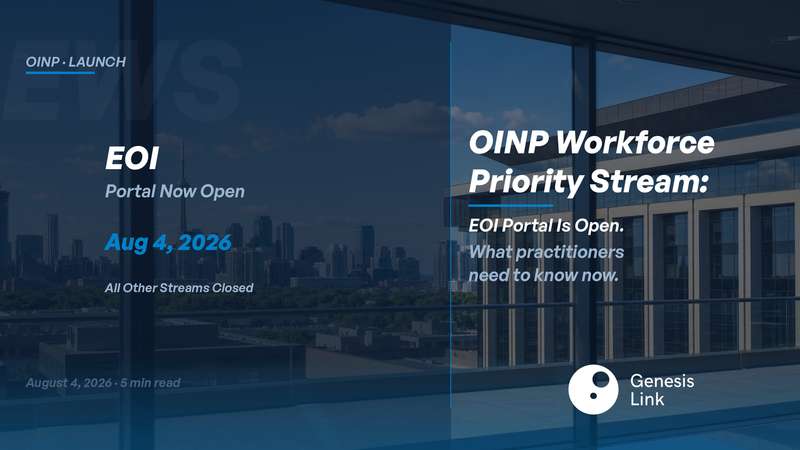
Ontario's entrepreneur stream was formally discontinued on May 30, 2026. No replacement timeline has been published as of June 2026. Non-residents who had been considering Ontario as a destination should review GenesisLink's OINP 2026 transition analysis and consult with their immigration professional regarding alternative provincial strategies.
From Work Permit to Permanent Residence — The Strategic Path
For most non-residents pursuing business immigration, the work permit is not the final destination — it is the first stage of a two-step strategy toward permanent residence.
The most structured path in 2026:
- Obtain a C11 or ICT work permit — establishing Canadian business presence and building Canadian work history
- Build an Express Entry profile — using Canadian Experience Class eligibility after 12 months of qualifying work in Canada
- Receive an Invitation to Apply (ITA) for permanent residence through Express Entry
This path requires careful sequencing. The work permit application must demonstrate genuine business intent. The business must then operate credibly enough to support Express Entry eligibility. And the business documentation must be maintained throughout — because IRCC may request evidence of ongoing operations at the PR stage.
GenesisLink's guide to Express Entry PR strategy after C11 covers the positioning decisions advisors need to anticipate before the work permit application is filed.
For PNP pathways, the timeline is longer but the PR outcome is more direct. Stage 1 of a PNP application results in a Business Establishment Agreement. Stage 2 — typically 12–24 months later — evaluates whether the entrepreneur has executed against the agreement. Successful Stage 2 review leads to a provincial nomination certificate, which then supports a permanent residence application through IRCC.
What Non-Residents Get Wrong About Business Immigration
After reviewing hundreds of business immigration files, three recurring gaps appear in applications from non-residents:
Treating the Business Plan as a Narrative
IRCC assessors do not read business plans as they would a pitch deck. They assess whether the business model is operationally credible, financially sound, and capable of generating the stated benefit to Canada. A plan that reads well but lacks detailed financial modeling, market sizing, and job creation timelines is evaluated as thin — regardless of how polished the writing is. GenesisLink's guide to writing an immigration-grade business plan outlines the documentation standard in full.
Underestimating Regional Specificity
PNP business streams are province-specific, and officers evaluate business plans with a regional lens. A retail or service concept designed for Vancouver will not pass a Manitoba PNP review without meaningful adaptation to Manitoba's market conditions, labour market, and community priorities. Community alignment is assessed in detail — not assumed from generic market research.
Owner-Manager Dependency
One of the most frequently cited weaknesses in C11 and PNP files is a business structure where the applicant is the sole operator, with no plan for delegation, staffing, or scalability. Officers assess whether the business can operate and generate benefit independently — not just sustain the founder. GenesisLink's analysis of owner-manager dependency in immigration business plans covers how to structure a file that demonstrates genuine operational depth.
The Role of a Business Consultant in Non-Resident Applications
The immigration professional — the RCIC or immigration lawyer — manages the legal and procedural dimensions of the application. The business consultant manages the evidence layer: the business plan, financial model, market analysis, and job creation framework.
These are distinct functions. An immigration professional advising a non-resident entrepreneur on a C11 or PNP application needs both components to be air-tight. The IRCC assessor evaluates the business case with the same scrutiny as the procedural eligibility — and often more, because the business case is where the most substantive judgment calls are made.
GenesisLink works exclusively with immigration professionals as their business consulting partner. We do not provide immigration advice or represent clients before IRCC. Our role is to make sure the business side of every file is defensible, credible, and execution-ready.
Frequently Asked Questions
Can a non-resident start a business in Canada without a work permit?
Non-residents can incorporate a Canadian business entity without a work permit. However, they cannot legally work in Canada — including managing operations from inside the country — without authorization. C11 and ICT work permits are the primary authorizations that allow non-residents to actively operate a Canadian business.
Is there a minimum investment required for business immigration to Canada?
It depends on the pathway. The C11 significant benefit work permit has no statutory minimum investment. ICT requires a $25,000 CAD government fee but no minimum business investment. PNP entrepreneur streams typically require $100,000 to $300,000 CAD in qualifying investment, depending on province and business location. Net worth requirements for PNP streams range from $250,000 to $600,000 CAD.
How long does business immigration take for non-residents?
Processing times vary by stream. C11 applications typically take 3–5 months for complete files. ICT applications can process in 60–90 days. PNP nominations follow two-stage processes — Stage 1 followed by Stage 2 review after 12–24 months of operation. Total timeline from initial application to permanent residence is typically 2–3 years via C11 plus Express Entry, and 3–5 years via PNP entrepreneur streams.
Does business immigration lead to permanent residence in Canada?
Yes. All active business immigration pathways are designed as stepping stones to permanent residence. Federal work permit holders (C11, ICT) typically transition through Express Entry's Canadian Experience Class. PNP nominees receive provincial nomination certificates that directly support permanent residence applications through IRCC's Express Entry or paper-based streams.
What is the strongest business immigration pathway for non-residents in 2026?
The optimal pathway depends on the applicant's profile. Entrepreneurs without an existing Canadian entity typically start with C11. Those with established international operations expanding to Canada use ICT. Those seeking provincial nomination and a structured path to permanent residence consider PNP entrepreneur streams. The right choice requires a detailed assessment of the applicant's business structure, financial position, timeline, and destination province.
What makes a business plan approvable for Canadian immigration?
An approvable plan demonstrates business viability, not just business intent. This means realistic financial projections grounded in market data, a credible job creation timeline, a business model that operates independently of the founder's sole involvement, and documentation that aligns with the specific requirements of the stream being applied under. Generic templates do not meet this standard.
Work with GenesisLink
GenesisLink supports immigration professionals and entrepreneurs in developing business plans, financial models, and documentation systems for C11, ICT, and PNP entrepreneur applications. Our approach is evidence-based and built around the specific standards that IRCC and provincial nomination authorities actually apply.
If you are advising a client on business immigration to Canada, or if you are a non-resident entrepreneur planning your own pathway, contact GenesisLink to discuss the business component of your file.




Discussion
Be the first to comment.
Add a comment