



Express Entry Senior Managers Draw #444: 250 ITAs at CRS 389
IRCC Express Entry Draw #444 (16 Sep 2026) invited 250 Senior Managers with Canadian work experience at CRS 389. What advisors should check on business-side files.
Read More60 items — blogs and news sharing this topic, most recent first.
IRCC Express Entry Draw #444 (16 Sep 2026) invited 250 Senior Managers with Canadian work experience at CRS 389. What advisors should check on business-side files.
Read More
When IRCC work permit processing times ease, C11 and ICT file strategy should tighten documentation quality, not loosen it.
Read More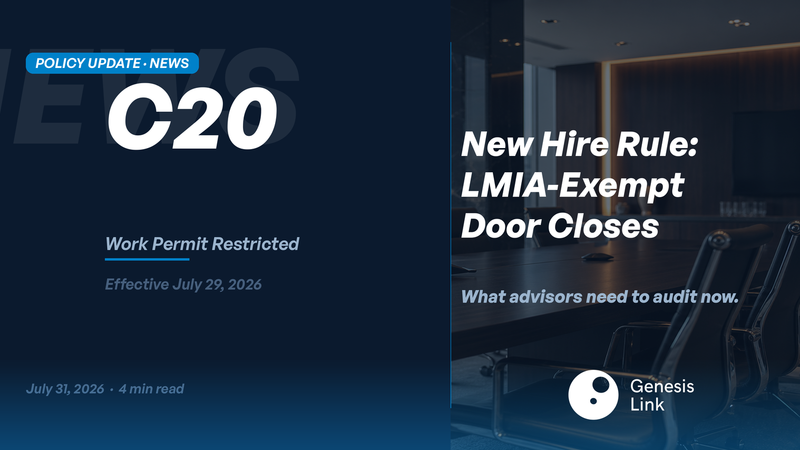
IRCC updated C20 reciprocal employment work permit rules on July 29, 2026. New hires whose employment begins only upon Canada arrival are now ineligible. Here is the 3-pathway framework advisors need to audit for active corporate files.
Read More
C10 work permits hinge on one test: Canadian public benefit. In 22 files reviewed since 2023, 68% of officer RFIs traced to a missing or generic benefit section. This framework shows how the documentation standard differs by sector.
Read More
In 22 C10 files reviewed since 2023, renewal refusals trace to a single documentation gap: no updated Canadian public benefit evidence. Here is what IRCC assesses at C10 work permit extension in 2026, including what changed after February's GCMS update.
Read More
In 22 C10 significant benefit work permit files reviewed since 2023, 68% of officer follow-up questions traced to the same documentation gap: the business plan described the applicant's role but did not articulate the Canadian public benefit their work creates. This guide covers the three public policy benefit filters officers apply, what a C10 business plan must contain, and what changed in the February 2026 GCMS update.
Read More
In 41 C11 files reviewed with RCICs, 66% drew officer questions on indispensability first. How officers sequence significant benefit assessments in 2026.
Read More
IRCC issued 500 ITAs in today's Senior Managers Express Entry draw at CRS 392 — down 37 points from March. Here's what it means for C11, ICT, and SUV work permit holders in Canada.
Read More
A C11 holder accumulating Canadian work experience is not automatically building toward CEC eligibility. There is a documentation gap that opens quietly during the work permit period — and by the time it surfaces, it is often too late to fix retroactively.
Read More
IRCC issued 2,000 ITAs in the July 7, 2026 Canadian Experience Class draw at a CRS cut-off of 517 — the lowest CEC score recorded in H2 2026. Here is what the data means for C11 and ICT work permit clients and the advisors managing their files.
Read More
C11 significant benefit under R205(a): four business-case pillars, corroboration standards, owner-manager dependency risk, and H2 2026 officer priorities for immigration professionals.
Read More
The significant benefit test is the make-or-break standard behind every C11 work permit application. Here is what officers actually weigh, what evidence holds up, and where files go wrong.
Read More
The C11 significant benefit test is the evidentiary core of every C11 work permit application. This guide breaks down the specific criteria, evidence thresholds, and documentation standards IRCC applies in 2026 — written for immigration practitioners advising entrepreneurs and business founders.
Read More
IRCC officers evaluating C11 files in 2026 are applying more scrutiny to the relationship between projected revenue and documented operating history. Here is the risk pattern practitioners need to understand before the next file goes to submission.
Read More
IRCC's June 24 update shows in-Canada work permit processing times dropped to 144 days — the lowest in 2026, down from 171 days. Here is what it means for C11 and ICT file strategy.
Read More
Receiving a PNP entrepreneur nomination is a major milestone — but the pathway to permanent residence has distinct requirements, timelines, and business compliance considerations that immigration advisors need to understand in 2026.
Read More
IRCC's June 17, 2026 update shows in-Canada work permit processing dropped 15 days to 171 days — still 51 days over service standard. Here is what the data means for C11 and ICT file strategy.
Read More
A specific calculation error appears across PNP entrepreneur files more than any other documentation problem — a structural mismatch between projected revenue and projected headcount. Here is how to identify and fix it before submission.
Read More
After 300+ files across C11, ICT, and PNP entrepreneur streams, GenesisLink's pre-submission audit consistently surfaces the same six business-side gaps — before they become IRCC outcomes. Here is what we find.
Read More
Internal contradictions between business plan sections — revenue projections that conflict with market size, job creation numbers that exceed the financial model's capacity — are among the most common reasons well-written C11 and PNP files receive Procedural Fairness Letters. Here is what an internal logic audit looks like, and why it should happen before every submission.
Read More
Most C11 work permit refusals trace back to a business case problem, not a legal error. This guide breaks down the six most common C11 work permit refusal reasons — from weak significant benefit arguments to dual funding failures — and outlines the documentation standards that prevent them.
Read More
Most immigration business plans are written for the wrong audience. This guide breaks down what IRCC actually evaluates — by program, by component, and by the standards that determine outcomes for C11, ICT, and PNP entrepreneur stream applicants.
Read MoreCanada's proposed Express Entry high-wage CRS factor places senior managers (NOC 00012/00014/00015) in the top bonus tiers. Here is what that means for PR pathway planning on C11 and ICT files in 2026.
Read More
The C11 significant benefit test is not about the applicant's business. It's about Canada. Most business plans answer the wrong question. Here's what officers actually look for, and how to restructure your files to pass.
Read More
IRCC is sending a 26-question due diligence letter to Startup Visa applicants. This guide explains what each question really means, how to answer it, and the evidence you need to back it up.
Read More
AI writing tools have reached immigration business files. In 2026, assessors are trained to identify what AI-generated plans produce — and the consequences go beyond a delayed decision. Here is what gets flagged, and what the standard actually looks like.
Read More
The federal Minister of Immigration laid out a clear roadmap at NCIC 2026: three Express Entry programs consolidate into one, starting this calendar year. Here is what practitioners and business clients need to know about the phased timeline, rural policy shifts, and new IRCC integrity partnerships.
Read More
Most ICT applications arrive with strong legal documentation — and still stall at the specialized knowledge review. Here is why the test requires business analysis, not legal argument, and how to build a case that holds up under officer scrutiny.
Read More
A refusal letter is not the end of a file. NCIC 2026 Session 3 breaks down the triage decision: when to request reconsideration, when to reapply, and when judicial review is the right call — including the 15-day and 60-day deadlines practitioners need to know.
Read More
Every immigration file passes through two distinct gates: eligibility and admissibility. NCIC 2026's screening session revealed how IRCC applies different legal thresholds across Sections 34–40 of IRPA — and what that means for how practitioners build their files.
Read More
IRCC's AI tools are live and operational. Here's what RCICs, immigration lawyers, and business immigration consultants need to know from NCIC 2026's opening AI panel — covering the passport photo checker, Geomatch, ML triage, the Chinook clarification, and VPN3.
Read More
Clearing the minimum investment threshold in a PNP business stream does not satisfy the financial requirement. Here is what provincial officers actually evaluate — and how to build a business case that holds up.
Read More
Most ICT applications open with a strong résumé and a senior job title. Neither satisfies IRCC's specialized knowledge standard. Here is what officers actually evaluate — and what makes files succeed.
Read More
Most ICT files describe a role and the applicant’s qualifications. IRCC officers evaluate something more specific. Here is what the specialized knowledge standard actually requires, and how to build a business case that reflects it.
Read More
ICT work permits have a reputation as the straightforward pathway. But the specialized knowledge standard is where most business cases break down. Here is what officers actually evaluate — and what a well-built ICT file documents.
Read More
IRCC's specialized knowledge test for ICT work permits is two-pronged and company-specific — not industry-wide. Here is why most applications get it wrong, and what a correctly documented file looks like.
Read More
Canada's 2026 Levels Plan boosted PNP nominations by 66% to 91,500 — the largest single-year increase in the program's history. For immigration professionals advising entrepreneur clients, this reallocation changes how files should be positioned, timed, and built. Here is what advisors need to know.
Read More
Most ICT work permit refusals trace back to the same gap: the file described expertise, but never proved specialized knowledge in the regulatory sense. Here is what IRCC's R205(a) standard actually requires — and how to build a file that answers the right question.
Read MoreMost ICT work permit files describe specialized knowledge through job titles and years of experience. IRCC officers evaluate something entirely different. Here is the dual-track framework behind the standard, where files break down, and what a defensible specialized knowledge package actually looks like.
Read MoreIRCC officers are increasingly identifying templated and AI-assisted business plans in immigration files. Here is what triggers the credibility flag, what it costs a file, and how practitioners can build documentation that holds up to scrutiny.
Read MoreThe word ‘specialized’ carries precise legal weight in ICT work permit applications. Most files fail not because the applicant lacks credentials, but because the documentation describes expertise rather than proprietary, company-specific knowledge. Here is what officers actually evaluate — and how to build documentation that meets the standard.
Read MoreMost ICT applications describe the applicant's credentials and call it specialized knowledge. IRCC's actual definition requires proprietary, company-specific knowledge unavailable in the Canadian labour market. Here is how to build the argument correctly.
Read MoreIn 2026 FC 283, the Federal Court confirmed that IRCC evaluates C11 significant benefit during the permit period — not from future projections. Here is what that means for how you build the file.
Read MoreMost C11 business plans lead with five-year projections and ambitious employment targets. Here is why that framing is misaligned with how IRCC actually adjudicates significant benefit — and what a defensible file looks like instead.
Read MoreEvery C11 and PNP entrepreneur file includes a job creation section. After reviewing hundreds of files, it is the element most likely to undermine an otherwise well-prepared application — not because practitioners ignore it, but because it is treated as a compliance checkbox rather than what IRCC actually evaluates.
Read More
Effective March 30, 2026, new federal regulations exclude PNP nominees whose nomination was based on passive investment. Here's what the new genuine management standard means for your files.
Read MoreThe most common reason C61 files fall short is not that the applicant lacks expertise. It is that the documentation does not meet IRCC's specific evidentiary standard for what 'specialized knowledge' actually means. Here is the test — and how to meet it.
Read MoreThe qualifying relationship is one of the two foundational pillars of any ICT application. When the corporate relationship between the foreign and Canadian entity cannot survive officer scrutiny, the entire file is at risk — regardless of how well-documented the applicant's role is. Here is what IRCC officers actually examine, and how to build a qualifying relationship package that holds up.
Read MoreMost advisors define specialized knowledge as advanced expertise. IRCC defines it as employer-specific, non-transferable knowledge built through employment. The gap between those two definitions is where ICT files fail. Here is what the definition actually requires and how to build a file around it.
Read More
Effective April 30, 2026, IRCC raised PR fees across all immigration categories. The business-class fee sees the steepest increase — up $85 to $1,895. Here is what every immigration advisor needs to review and update right now.
Read More
The ‘specialized knowledge’ standard for ICT work permits is more precise than most files demonstrate. Here is what IRCC is actually evaluating — and the three documentation gaps that consistently separate refusals from approvals.
Read More
Starting April 30, IRCC raises permanent residence fees across every PR category. Here is what business immigration advisors need to review, recalculate, and act on before the deadline.
Read MoreIRCC's interpretation of specialized knowledge in ICT work permit applications has tightened significantly. Files that passed review two years ago are being refused on the same documentation today. Here is what the definition actually requires — and what strong files contain.
Read MoreBusiness-class PR applications face the largest fee hike (+$85 to $1,895) effective April 30, 2026 at 9 AM Eastern. PNP fees also rise by $40. Applications submitted and paid before the deadline lock in current rates. Here is what immigration professionals need to review today.
Read More
The C11 Significant Benefit Work Permit is now Canada's primary federal pathway for entrepreneurs after the Start-Up Visa closure. But widespread myths about how IRCC evaluates these files are getting strong applicants refused. We break down five of them.
Read More
In recent months, a notable shift has been observed in IRCC’s post-approval monitoring of Startup Visa applicants and their consulting representatives.
Read More
From Intake to Approval: The Power of Detailed Inputs in Business Plans
Read More
Avoiding Common Compliance Mistakes in Startup Visa Cases
Read More
The Risks of Relying on AI-Generated Business Plans: Why Algorithmic Outlines Fail Immigration Standards
Read More
Why IRCC is Prioritizing Experience and Advanced Degrees in 2026
Read More