


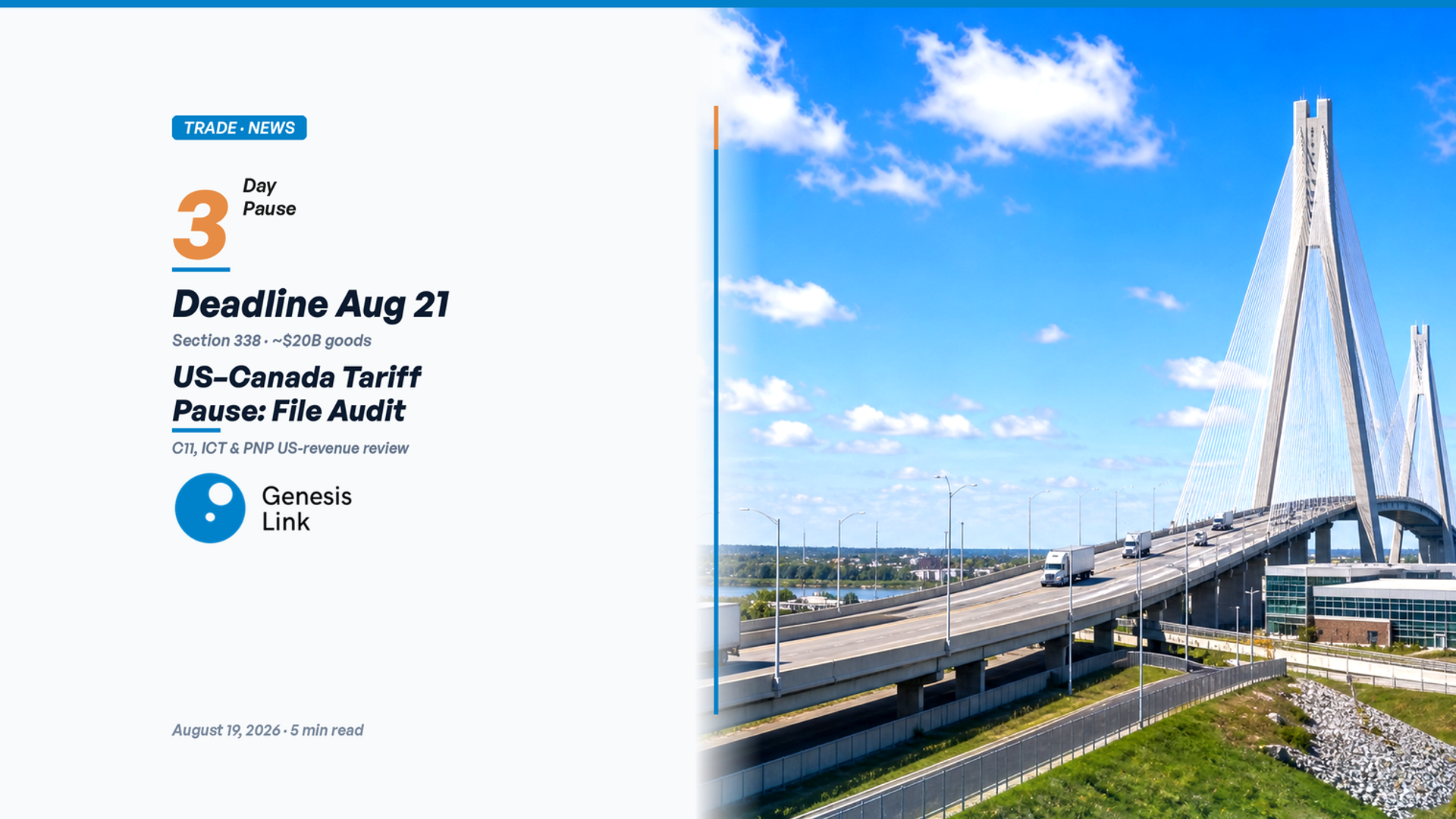
US–Canada Section 338 Tariff Pause to August 21, 2026: What C11, ICT and PNP Files Still Need
The U.S. paused planned 50% Section 338 tariffs on roughly $20B of Canadian goods until end of day August 21, 2026, subject to final documents. What advisors should audit in active C11, ICT, and PNP business plans now.
Last reviewed: 19 August 2026. Trade posture can change within hours. Confirm any final agreement language against primary government and White House releases before you brief a client file.
Less than two hours before a scheduled midnight start, the United States paused planned 50% Section 338 tariffs on a range of Canadian goods. U.S. President Donald Trump said the pause lasts three days and is tied to a deal that remains subject to finalization of documents. Canadian Prime Minister Mark Carney confirmed that the United States agreed to postpone implementation until end of day, 21 August 2026, while stating that substantial progress had been made and important work remained.
Reporting from major wires (including AP via PBS NewsHour) places the threatened package at roughly $20 billion of Canadian goods, with coverage that can reach categories well beyond the commodities that dominate headlines. Section 338 of the U.S. Tariff Act of 1930 is the legal hook cited for the measure. Multiple outlets note this is an unusual use of that authority in the current dispute.
What changed overnight
- Pause, not permanent repeal: Duties that were set to start overnight did not take effect as scheduled. The clock now runs to end of day 21 August 2026 unless parties extend or finalize further language.
- Deal language is incomplete: Trump described a deal subject to document finalization. Carney emphasized progress plus unfinished work. Advisors should not treat social-media wording as a closed commercial treaty text.
- Leverage remains live: The Section 338 threat still sits on the table through the pause window. Supply-chain and revenue assumptions that depend on stable Canada–U.S. duty treatment stay under review.
- Broader negotiation context: Public reporting ties the dispute to U.S. complaints about treatment of U.S. alcohol, dairy, and motor vehicle interests, provincial alcohol measures, and ongoing USMCA-era friction. Pipeline commentary (including Keystone XL references in U.S. messaging) is political colour, not a substitute for tariff schedule text.
Why this still matters for C11, ICT, and PNP files
A three-day pause reduces immediate shock. It does not restore multi-year certainty for officers reading a business plan. Files that still project heavy U.S. sales, U.S. supply inputs, or cross-border logistics as the core Canadian benefit story need the same audit you would run if duties had started on schedule.
In our earlier July–August review of active C10/C11/ICT packages, a meaningful share of plans still carried U.S. revenue concentration above roughly one-fifth of projected income without a written stress case. That pattern remains the binding risk for practitioners even after a short political delay.
Four-item file audit before Friday’s deadline
- Revenue geography: Split Canadian, U.S., and other revenue by year. Flag any year where U.S. share drives the “significant benefit,” job, or viability narrative.
- Cost and margin bridge: Model a 50% duty on the relevant import lines and a no-duty base case. Show which Canadian jobs, CAPEX, or local sourcing steps survive each path.
- Customer and contract evidence: Prefer LOIs, purchase history, and Canadian demand proof that do not collapse if U.S. channel economics change during the pause or after 21 August.
- Pathway fit: C11/ICT packages must still show Canadian benefit and operational substance under IRCC standards. PNP entrepreneur plans must still show provincial market fit and job logic that is not only a U.S. re-export story.
What our files show
The costliest response after the July tariff announcements was freezing every Canada plan that mentioned the United States. The better response is a dual track: keep the Canada establishment story strong, and document how the business absorbs tariff volatility without abandoning Canadian hiring or management substance. A pause to 21 August is useful only if the documentation work happens inside the window.
Advisor actions this week
- Re-open any active C11, ICT, or PNP draft with U.S. revenue or U.S. input cost above a material threshold.
- Add a one-page trade-sensitivity annex (base case / duty case / Canadian substitution steps).
- Do not delete U.S. market discussion; rebalance it so Canadian benefit does not depend on a single duty outcome.
- Watch for a signed text or a further extension after 21 August before you lock multi-year financials in client decks.
FAQ
Did the 50% tariffs start on 19 August 2026?
No. Public statements from both sides describe a short postponement. Carney’s statement points to end of day 21 August 2026 for the postponed Section 338 implementation while talks continue.
Is USMCA protection automatic for these goods?
Do not assume automatic insulation. Reporting on this package has repeatedly stressed that the threatened duties can reach goods that previously moved under preferential North American treatment. Confirm product-level treatment against primary legal text when it is published.
Should we pause C11 or PNP filings until a final deal?
Status clocks and nomination clocks rarely wait for trade politics. Strengthen the Canadian evidence base now. Update financial annexes if a final deal or a renewed duty list lands after 21 August.
Author: Sajad Bahramian, Marketing and Sales Lead, GenesisLink. GenesisLink is a business consulting firm; we do not provide immigration legal advice or trade-law opinions. Confirm figures on primary government pages and official proclamations before you brief a client or file.
Discussion
Be the first to comment.
Add a comment