


Refused, Flagged, or Stuck: Protecting Business-Immigration Clients Under IRCC’s New Scrutiny
Refused, Flagged, or Stuck: Protecting Business-Immigration Clients Under IRCC’s New Scrutiny
Updated 04-Aug-2026 • 60 min
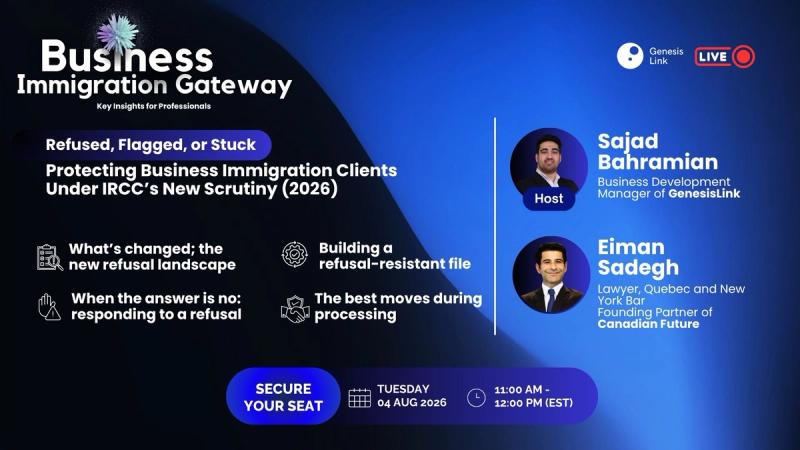
For years, the question in business immigration was straightforward: does this file meet the criteria of the program? In 2026, that question has quietly changed. Files that met the criteria a year ago are being refused today on grounds officers now weigh differently — around credibility, temporary intent, financial reserves, and the genuineness of the business itself. What passed a lighter review in 2024 is being returned for substantiation in 2026, and practitioners across the country are watching approvable files fail on grounds that did not exist, or were not enforced, twelve months ago.
In this session, we walked through the current refusal landscape in Canadian business immigration — and, more importantly, what to do about it. Our guest, Eiman Sadegh, has been practising Canadian immigration law since 2009 and is the Founder of Canadian Future Law Firm in Montreal. He is a member of both the Quebec and New York Bars, and his practice concentrates on Federal Court judicial reviews of immigration refusals, mandamus applications for unreasonable processing delays, and complex business immigration files — including owner-operator work permits, LMIA-exempt Section 205 work permits, the Start-Up Visa program, and the Quebec entrepreneur streams. He joined us in a personal, educational capacity to share what he sees walking through his door each week.
What we covered
The shift from eligibility to credibility. Eiman opened with a framing that would recur throughout the session: since 2009, business immigration criteria have moved in one direction — categorically more restrictive. The bar for a C11 work permit in 2019–2020 (registered corporation, business plan, landing page, small office) is nowhere near sufficient today. What officers now assess is not whether the file meets the technical criteria of a program, but whether the corporation is actually doing something in the world. "It's not 'yes, I checked that box,'" he said, "but more than that: what is this corporation doing? How can I show that it's actually begun activities, that it's a genuine endeavour, and not a business plan I developed just to get a work permit." He connected this to two related shifts: the May 2025 repositioning of the C11 owner-operator work permit around "temporary residence intent," which now requires a materialized exit plan for both the applicant and the corporation; and the emergence of the "all-in" financial red flag, where an applicant investing 100% of their personal net worth into a Canadian business is now itself grounds for refusal because it demonstrates no reserves against the ordinary risks of running a business.
Building a refusal-resistant file. Asked what concretely separates a file that gets approved from one with almost no chance, Eiman offered a mental exercise rather than a checklist: proceed as though the immigration case did not exist, and ask what a genuine operator would be doing for this business today — then document that. He walked us through an anonymized C11 file for a Turkish entrepreneur linking Canadian aerospace-parts manufacturers to Turkish distributors. The work permit processing took roughly eighteen months. What got the file through was not the paper: the applicant visited Canada, opened a Canadian corporate bank account and funded it, met with Canadian suppliers and distributors in person, and documented email exchanges evidencing potential clients. "Forget about the visa for a second," he said. "What would you be doing if you were actually doing this business? That's where you get the answers to the credibility question."
Responding to a refusal: the three-parallel-routes strategy. When a refusal lands, Eiman's first move is to read the notes — Officer Discretionary Notes for temporary residency refusals, GCMS notes for permanent residence refusals — and reconstruct the officer's decision-making logic against the facts on file. Only then does he decide which route to pursue. For temporary residency applications, his strategy is to run all three response routes in parallel: reconsideration (discretionary, fast when it works, often ignored), resubmission (only after understanding what actually failed), and Federal Court judicial review (slow but binding). Whichever produces a result first wins; the others are withdrawn. For PR refusals, resubmission is often no longer possible — eligibility documents or program status may have changed — leaving reconsideration and judicial review as the practical options. He also flagged the "tennis match" phenomenon: a case he has won at Federal Court three times, refused again on each remittal, now positioned for costs and damages precisely because the pattern is itself unreasonable.
Challenging AI-generated refusals. IRCC's official line — repeated at industry meetings by the department's AI division director — is that artificial intelligence analyzes files and surfaces information for officers but does not make decisions. In practice, practitioners are seeing Officer Discretionary Notes that read as unreviewed AI output: two to three pages of "verbal splash" that lists everything and anything in the file without coherent reasoning. Eiman's approach on these files is to request reconsideration explicitly noting the incoherence, and to expect Federal Court settlement relatively quickly if it comes to that. He also emphasized protecting the client from any misrepresentation-adjacent characterization in the notes, which can otherwise trigger a five-year bar exposure.
Processing waits, the SUV backlog, and the 2026 Federal Court quota decision. For files sitting in processing — particularly Start-Up Visa applicants whose waits routinely exceed three years — Eiman's frame is that the business plan on submission day may no longer be executable when the file finally receives attention. If that is the case, the practitioner's job is to help the client pivot pragmatically and document that pivot clearly for IRCC. He also shared a practical tactic: even without an Acknowledgement of Receipt, requesting the temporary file number from IRCC often works, and that number is the reference required to file mandamus if the wait becomes unreasonable. Most importantly, he flagged a Federal Court decision from early 2026 on a quota-based program structurally similar to the SUV, in which the Court held that IRCC must complete internal processing — eligibility, security background, medical — even where a quota constrains the ultimate nomination. IRCC cannot use "the quota hasn't reached you yet" as a defence to indefinite non-processing. For SUV applicants who filed between 2021 and 2024 and are still sitting with no substantive activity on their file, this decision opens a mandamus-style enforcement path that was not clearly available before.
Live audience Q&A
Eiman also answered practitioner questions on the practical value of contacting an MP for a delayed file (his answer, from years of practice: MPs will always inquire, but he has never seen an MP intervention reverse a decision or meaningfully accelerate a file), how to distinguish a legitimate program-switch from immigration shopping when a client has a prior refusal on record, what to do when a PNP nomination is withheld despite the client meeting their performance agreement, and what remains possible for Start-Up Visa clients caught in the current pipeline.
The one thread through it all
In 2026, credibility is the currency and the operator is the audit. Files survive because the corporation is actually doing something in the world — not because the paperwork claims it will. As Eiman put it in closing: "Immigration is cyclical. We are at the bottom of the cycle at the present moment." Until the pathways open again, the practitioner's job is to build files that survive current scrutiny — and to prepare clients for the reality that the pattern will keep moving.
This session was educational and general in nature and is not legal or immigration advice. Our guest joined in a personal, educational capacity; his views are his own and do not represent his firm or any regulatory body. For advice on a specific file, please consult a licensed professional.
Speakers