


Inside the Officer's Mind: What Gets a Business File Flagged — and How RCICs Respond
Inside the Officer's Mind: What Gets a Business File Flagged — and How RCICs Respond
Updated 23-Jun-2026 • 60 min
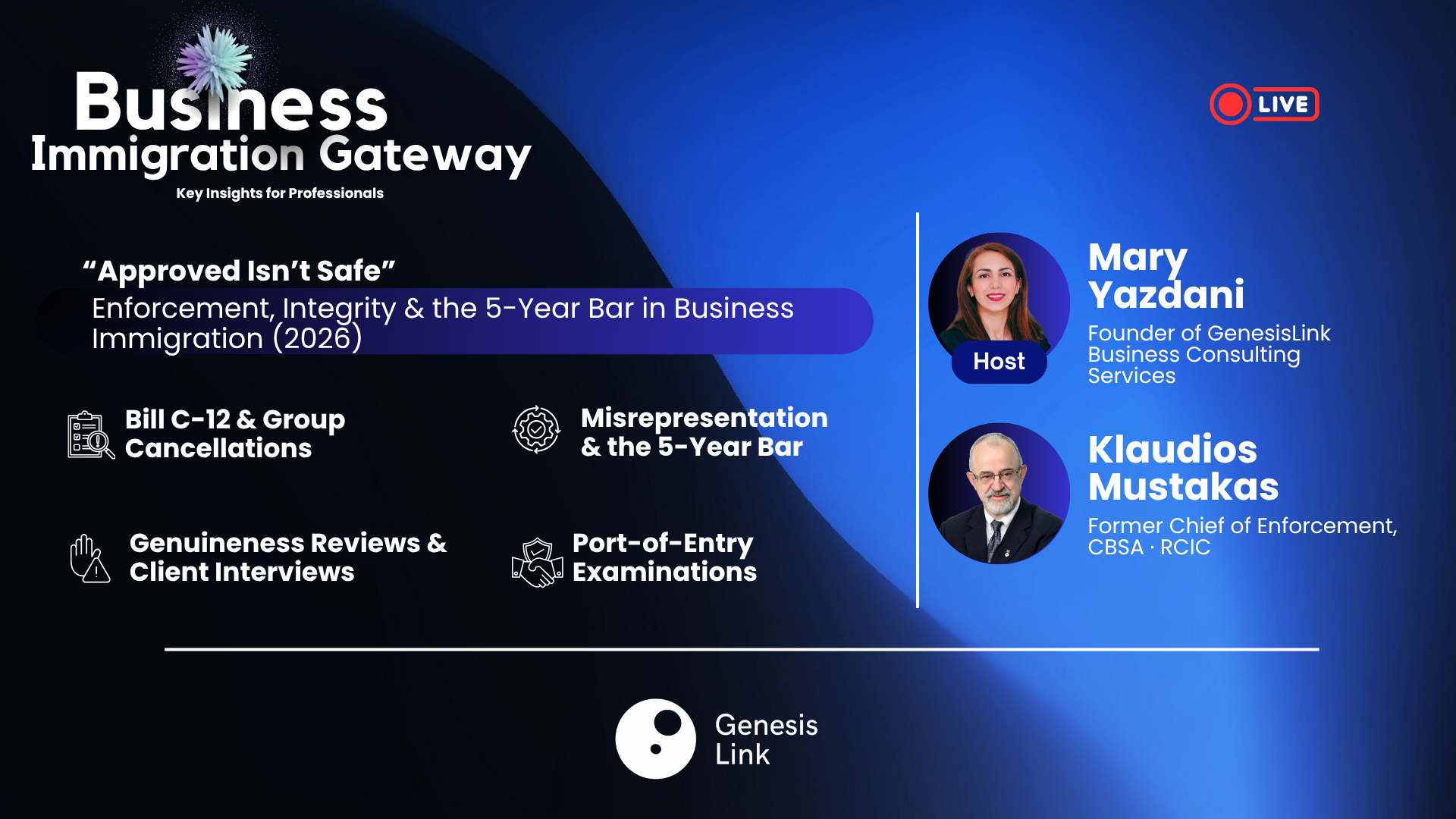
Featuring Klaudios Mustakas, RCIC — Former Chief of Enforcement, Canada Border Services Agency
For years, the job in business immigration was simple: get the file approved. In 2026, the rules around integrity and enforcement have changed what "approved" even means. Across all temporary resident applications, roughly half were refused in 2024 — up from about a third the year before — and the system has shifted from intake to scrutiny.
In this session, we followed a business immigration file from plan to decision and looked at every point where it can break. Our guest, Klaudios Mustakas, spent more than 40 years inside Canada's immigration and border system — as a visa officer on diplomatic postings, a senior manager at Citizenship and Immigration Canada, and finally as Chief of Enforcement at the CBSA. He is a two-time recipient of the Governor General's Peace Officer Exemplary Service Medal and teaches the immigration enforcement course at Queen's University Law School. He joined us in a personal, educational capacity to explain how officers actually think — from the other side of the desk.
What we covered
Bill C-12 and the power to cancel applications on a group basis. In force since March 26, 2026, the legislation gives IRCC the authority to cancel applications en masse. Klaudios explained why the Start-Up Visa backlog is, in his view, the most exposed group — and why there is little a representative can do to "prepare" until a specific file receives a procedural fairness letter. Drawing on the Harper-era backlog cancellations that flooded the Federal Court, he explained why the department built this authority precisely to avoid case-by-case prioritization: if a cancellation comes, it is likely to be a mass mail-out rather than a file-by-file review.
Misrepresentation and the Section 40 five-year bar. Where is the line between an honest mistake and a material misrepresentation? Klaudios walked through how officers test the most common flashpoint — source of funds — and what a strong fairness-letter response looks like: address each concern point by point, back every claim with third-party evidence (bank statements, sale documents, updated language results), and resist the urge to "throw in the kitchen sink." A critical warning for practitioners: the five-year bar can apply even when the misstatement was unintentional or introduced by a representative — and it is the client who bears the consequence.
AI-generated business plans and the credibility problem. Officers can tell when a plan wasn't written by the applicant or their representative. Klaudios's advice was direct: if you use AI, read the plan yourself first, and read it in the shoes of the officer who will assess it. We discussed the specific failure modes — overclaiming ("$100 million in year two," "15 hires and $2 million invested" that the client cannot prove), unbacked market-research figures, and fabricated sources. Length is not credibility; a short, provable plan beats a hundred pages of projection every time.
Genuineness, red flags, and post-approval compliance. Once a file is flagged, it moves to the back burner while officers run their own background checks — and, with in-person interviews largely gone, it is what's on paper that makes or breaks the case. Klaudios explained why genuineness is no longer judged only at approval: a significant share of business owner-operator permit holders may now face a post-approval compliance review — a site visit, document audit, or interview to confirm the business is real and active. He connected this to the history that shaped today's climate, including why the owner-operator work permit stream was effectively eliminated after the government found the overwhelming majority of a sample had no genuine business behind them.
Port-of-entry examinations and the limits of the Federal Court. Two clarifications that surprise many practitioners: clients do not have the right to counsel during a port-of-entry examination — a representative may be permitted to observe, but not to speak or present evidence on the client's behalf. And a positive Federal Court decision does not mean approval; it typically orders only that another officer reconsider the file, which can end in the same refusal.
Live audience Q&A
Klaudios also answered practitioner questions on misrepresentation raised after a withdrawal request, whether IRCC retains historical data on withdrawn files, filing a C11 application while a Start-Up Visa file sits in the backlog (yes — but stay consistent and be ready to explain your source of funds), the timing risks of withdrawing a file already in processing, potential legal recourse against mass cancellations under Bill C-12, and the true purpose of the LMIA process.
The one thread through it all
In 2026, approval is the start of the risk, not the end of it — and a consultant's diligence is what protects the client and the practitioner alike. As Klaudios put it repeatedly: be consistent across every document, in every application, over time.
This session was educational and general in nature and is not legal or immigration advice. Our guest joined in a personal, educational capacity; his views are his own and do not represent any government department. For advice on a specific file, please consult a licensed professional.