



- GenesisLink
 July 28, 2026
 Business Immigration
With IRCC processing at 124 days, C10 files submitted in March. April 2026 are in active adjudication now. Here's what the current queue means for how advisors should position active applications.
With IRCC processing in-Canada work permit applications at 124 days as of July 2026, every C10 Significant Benefit file submitted between late March and late April 2026 is now in active adjudication. For RCICs and lawyers managing those files, the next 30 days are a critical window. Not for new applications, but for understanding what officers are evaluating right now.
The 124-Day Clock and What It Means for C10 Files
IRCC's current in-Canada work permit processing standard sits at 124 days for complex files, including C10 applications under R205(a) Significant Benefit. Applications submitted between March 27 and April 28, 2026 are reaching the final review stage in August 2026.
For advisors with clients in this window, this is the period when officer questions arrive. And when a well-documented file holds a clear advantage over one that isn't.
This processing reality also shapes forward strategy. Clients who need a C10 work permit in force before November 2026 are past the comfortable filing window. Any application submitted now targets a November to December 2026 decision.
The February 2026 GCMS Update: What "Demonstrable" Actually Means
In February 2026, IRCC updated its internal GCMS guidance language for C10 assessments. The previous standard referenced "Canadian public benefit" as an implied test. The updated language requires benefit that is "demonstrable" and "articulated" within the application record itself.
In 22 C10 files we have reviewed since 2023, 68% of officer questions. 15 of 22. Traced directly to one root cause: the absence of an explicit, measurable Canadian Public Benefit section in the business plan or supporting documentation.
The February 2026 update codified what officers were already asking for. Files currently in adjudication must meet that standard.
Three Officer Filters Active in August 2026
C10 has three distinct benefit filters. Officers apply all three, but they do not weight them equally across applicant types:
- Economic benefit. Job creation, revenue generation, investment into Canadian operations.
- Social or cultural benefit. Contributions to communities, underserved regions, or cultural infrastructure.
- Research or innovation benefit. Academic partnerships, IP development, sector advancement.
The most common filing error in our review work: applicants whose work maps to the social or cultural filter but whose documentation leads with economic metrics alone. Officers will question that mismatch.
Four Items to Monitor Through August 2026
- Officer requests on March. April 2026 C10 files. If a client's application falls in this window, expect correspondence in August or early September. Have the supplemental documentation ready before it arrives.
- The BC PNP Entrepreneur draw gap. With no BC PNP Entrepreneur draw since June 30, some EOI holders are exploring C10 as an interim federal work authorisation. That file type requires a different business plan structure than PNP documentation.
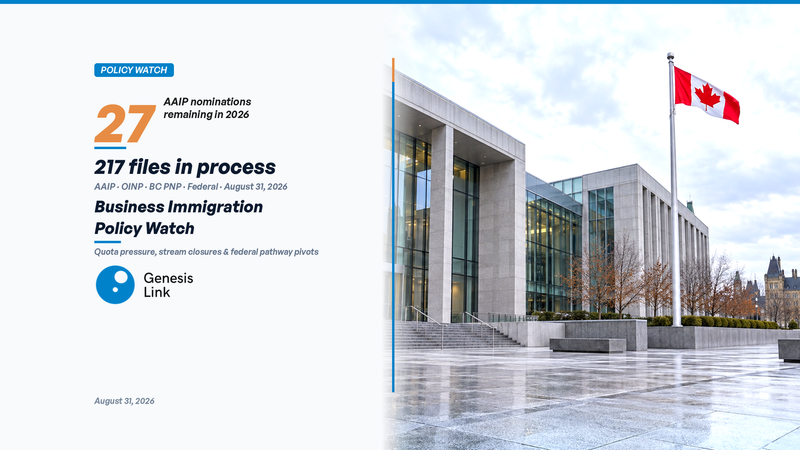
- AAIP entrepreneur allocation ratio. Alberta's entrepreneur stream remains at a 3.67:1 pressure ratio (242 in-process files against 66 remaining spots). Some of those applicants hold businesses with genuine public-benefit dimensions. A C10 co-pathway analysis may be worth running before nomination decisions arrive.
- Project-timeline alignment. C10 files tied to time-bound projects. Festivals, research grants, cultural programs. Carry a specific risk: if the project concludes before the permit is approved, the public benefit claim weakens on its face. For August filings targeting H1 2027 project start dates, the timing is workable, but the documentation must pre-empt the timeline question explicitly.
For advisors and entrepreneurs on active C10 files:
- If your client's application was submitted between March 27 and April 28, 2026, expect officer review correspondence in August. Confirm supporting documentation is current and accessible.
- Review the Canadian Public Benefit section against the February 2026 "demonstrable and articulated benefit" standard. Not the pre-February implied standard.
- Confirm that documentation uses the correct benefit filter for the applicant's actual work. Economic-only framing on a cultural or social-benefit file is a common officer trigger.
- If the application has a co-pathway to C11 (owner-operator of an operating Canadian business), confirm the correct code was selected. Wrong-code submissions are the most common pre-submission audit flag in our file review work.
For a full breakdown of what C10 business plan documentation must include under the current standard, see our detailed guide: C10 Work Permit Business Plan Requirements 2026.
If you are working on a file where C10 and C11 both apply, the benefit test distinction determines more than the code: C10 vs C11 Significant Benefit 2026.
Frequently Asked Questions
What is the difference between C10 and C11 for work permit purposes in Canada?
Both C10 and C11 fall under R205(a) Significant Benefit, but they apply different tests. C10 asks whether the work generates Canadian public benefit. Economic, social/cultural, or research/innovation. C11 asks whether the applicant is indispensable to the operation of a Canadian business. A file where the applicant owns a business that also generates cultural or community benefit may qualify under either code. But the documentation must lead with the correct test for the selected code.
How does IRCC assess "demonstrable benefit" for a C10 work permit application in 2026?
Since the February 2026 GCMS update, officers require that Canadian public benefit be explicitly stated, measured, and traceable within the application record. Not implied from the nature of the work. In 22 C10 files we reviewed since 2023, 68% of officer questions traced to files where benefit was described in general terms rather than articulated with measurable outcomes and Canadian-facing specifics.
What happens if an IRCC officer defers a C10 work permit application on benefit grounds?
A deferral is not a refusal. When a C10 file is deferred on benefit grounds, the applicant typically has an opportunity to respond to the officer's specific questions with supplemental documentation. The response window is defined in the officer's correspondence. For files deferred because the benefit section was absent or too general, that section can be added at the response stage. But it is significantly more straightforward to build this documentation before the initial submission.
Can a C10 work permit be used by entrepreneurs who own Canadian businesses?
C10 can apply to business owners where the primary significance is Canadian public benefit from the business's activities. For example, a cultural enterprise, a research-driven company, or an operation generating measurable community benefit. Where the primary argument is the applicant's indispensability to the business operation, C11 is the more appropriate code. Wrong-code selection is the most common pre-submission audit flag we surface in our file review partnership work with RCICs.
How long does IRCC take to process a C10 work permit application in Canada in 2026?
As of July 2026, IRCC is processing in-Canada complex work permit applications, including C10 Significant Benefit files, at approximately 124 days. This means applications submitted in August 2026 should plan for decisions in November to December 2026. Processing times are reviewed monthly by IRCC and can shift based on application volume and staffing.




Discussion
Be the first to comment.
Add a comment