


CRA Launches Self-Service Debt Resolution for Small Businesses in My Business Account
The Canada Revenue Agency expands digital self-service for Canadian small businesses, introducing Manage Balance for corporate debt resolution, Apple Pay options, and automated SIN security alerts.
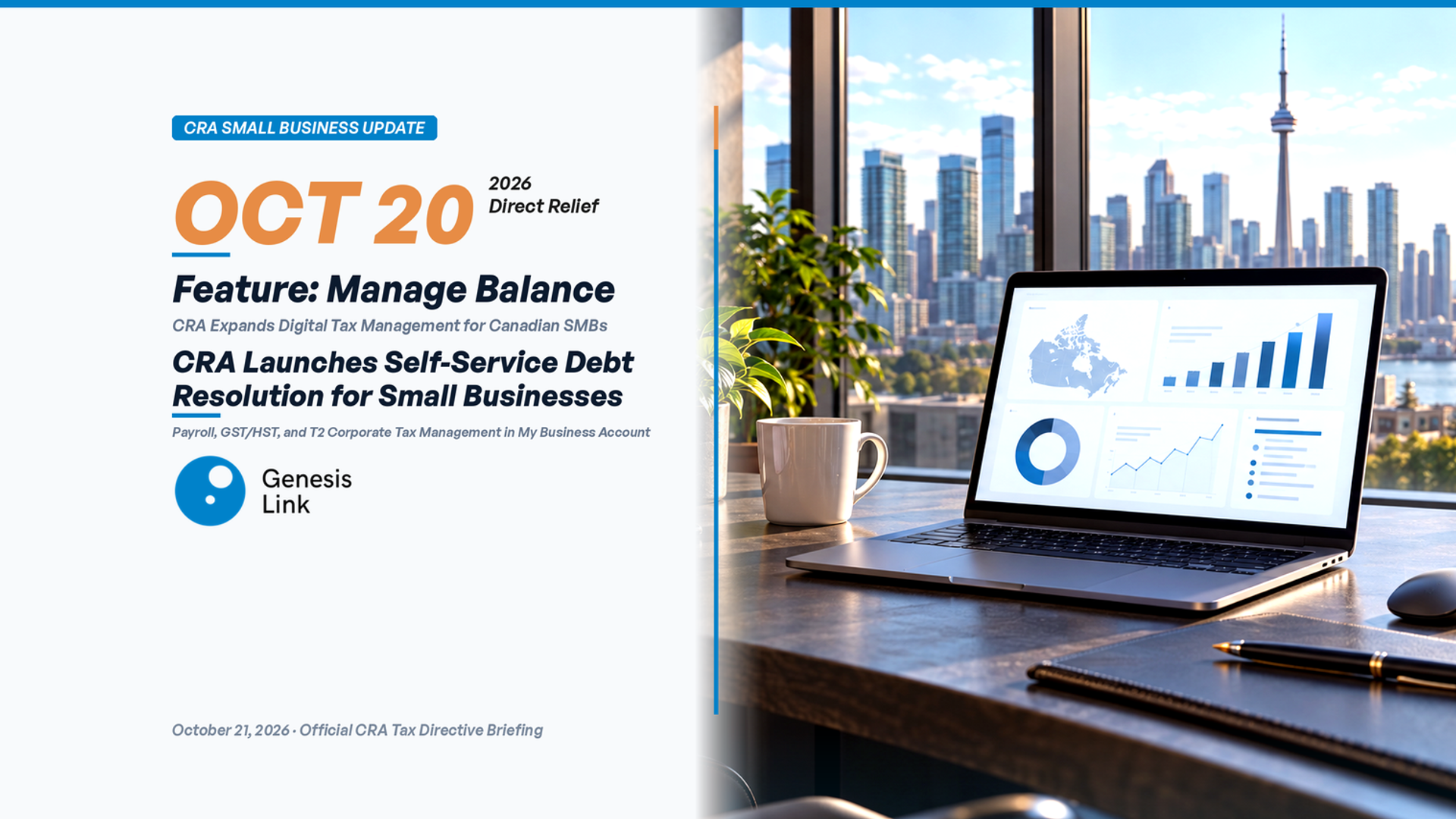
60-Second Key Takeaways for Canadian Business Owners & Advisors
- New Self-Service Debt Resolution: The Canada Revenue Agency (CRA) has officially expanded its "Manage balance" service to My Business Account as of October 20, 2026, allowing corporate directors and business owners to negotiate online payment arrangements across payroll deductions, GST/HST remittances, and T2 corporate income tax without telephone escalation to collections officers.
- Authorized Representative Restriction: Manage Balance is strictly limited to business principals inside My Business Account. Accountants, bookkeepers, and legal representatives cannot execute payment agreements via "Represent a Client," requiring direct client participation for resolution.
- New Payment Rails Active: As of October 19, 2026, CRA has integrated Apple Pay, Google Pay, and Konek (Interac Direct) across digital payment channels, expanding settlement options for corporate liabilities.
- Enhanced Corporate Security: Automated real-time email alerts are now triggered to personal T1 profiles whenever a Social Insurance Number (SIN) is linked or updated on a corporate business number (BN).
- Operational Impact for Newcomer Operators: Foreign entrepreneurs operating under C11, ICT, or provincial nominee business performance agreements gain immediate transparency over corporate tax compliance standing, safeguarding permanent residency milestones against unresolved administrative arrears.
What Has the Canada Revenue Agency Changed for Small Businesses?
On October 20, 2026, coinciding with Canadian Small Business Week, the Canada Revenue Agency (CRA) released an official operational briefing introducing digital self-service capabilities for Canadian corporations and unincorporated business owners. The centerpiece of this administrative release is the expansion of the "Manage balance" portal into My Business Account.
Historically, when a Canadian operating company encountered temporary cash flow friction resulting in outstanding balances across corporate income tax (T2), payroll source deductions, or GST/HST remittances, establishing a structured payment arrangement required direct correspondence or telephone negotiation with CRA debt management and collections officers. For corporate directors, immigrant entrepreneurs, and high-growth SMEs, this process frequently created administrative drag, delayed statements of account, and heightened audit vulnerability.
Under the newly deployed architecture, eligible business owners, corporate directors, and officers can log in directly to My Business Account to inspect liabilities, evaluate structured installment schedules, execute formal payment agreements, and request secure call-backs when specialized adjustments are required.
How Does the Expanded CRA Digital Architecture Compare to Prior Rules?
Why Must Professional Advisors Note the "Represent a Client" Exclusion?
For certified professional accountants (CPAs), bookkeepers, and corporate immigration legal teams, the most critical operational detail in the CRA update is an access boundary: Manage Balance for Businesses is not enabled through Represent a Client.
While external advisors frequently maintain Level 2 or Level 3 authorization on a corporation's Business Number, they cannot negotiate or bind the company to an automated installment agreement through their professional portal. Corporate officers must sign in directly using their personal credential broker or CRA login to confirm terms. Advisors should immediately update their client onboarding protocols to guide business founders through direct access verification rather than attempting portal-side resolutions.
What Our Files Show: Corporate Tax Standing in Business Immigration
Across more than 300 business files managed at GenesisLink, tax compliance integrity is consistently among the top documentary proofs requested by IRCC and provincial nomination offices. In C11 work permit renewals, ICT extensions, and provincial nominee final nomination audits (such as BC PNP and AAIP), officers cross-reference business activity against filed T2 schedules, payroll remittances (PD7A statements), and GST/HST filings. An unmonitored tax arrears balance or late payroll filing can stall an active permanent residence transition. The ability for business operators to self-audit, clear balances immediately, and secure instant payment documentation removes significant evidentiary friction.
How Do the New Payment Rails and Security Controls Protect Businesses?
Alongside debt resolution, the CRA expanded payment flexibility effective October 19, 2026. Businesses can now utilize Apple Pay and Google Pay (supporting Visa Debit and Debit Mastercard), as well as Konek for direct bank account clearing. This enables rapid remittance settlement during critical cash-flow reconciliation periods.
Simultaneously, the agency addressed heightened corporate identity risks. Corporate directors now receive immediate automated email alerts at their personal T1 registered email address whenever their Social Insurance Number is linked, amended, or cited on a corporate business number. For newcomer founders who may utilize multiple third-party service providers during market entry, this creates an essential security perimeter against unauthorized corporate registrations or administrative fraud.
Frequently Asked Questions (FAQ)
Can an authorized corporate accountant set up a Manage Balance payment agreement?
No. The CRA has explicitly excluded Represent a Client from this feature. Corporate directors or designated signing officers must log in directly to My Business Account to establish agreements.
Which tax program accounts are supported under the new self-service tool?
The service supports outstanding corporate income tax (RC / T2), payroll source deductions (RP), and Goods and Services Tax / Harmonized Sales Tax (RT / GST/HST) accounts.
Does entering into an online payment arrangement stop CRA late-filing interest?
No. Mandatory prescribed interest continues to accrue on outstanding tax balances until fully satisfied. However, a formalized arrangement prevents escalated legal enforcement action or third-party bank garnishments.
How does corporate tax compliance impact C11 work permit or PNP entrepreneur files?
IRCC and provincial nomination officers evaluate ongoing business viability through evidence of tax compliance. Clean statements of account, up-to-date payroll remittances, and filed T2 returns serve as primary proof of active commercial execution in Canada.
What should a business director do if they receive an unexpected SIN alert?
If you receive an automated notification regarding an unrequested SIN update on a corporate account, immediately contact the CRA Business Enquiries line at 1-800-959-5525 to verify account integrity and prevent unauthorized activity.
Strategic Business Execution & Compliance Support
GenesisLink collaborates with immigration professionals, accountants, and foreign entrepreneurs to deliver structured business documentation, commercial viability planning, and compliance monitoring across Canada.
Recent News

 October 21, 2026


More on Small business growth
 NewsFedDev Ontario Opens $700M Regional AI Initiative for Small Businesses
 NewsBDC Small Business Week 2026: 78% of Canadian SMEs Pivot to Growth Amid Economic Volatility
 NewsOntario Agri-Tech Innovation Initiative: $100K Equipment & Technology Intake Closes October 29
 NewsSmall Business Week 2026: Federal & Regional Capital Windows Open for Canadian SMEs
 NewsBDC Small Business Week 2026: 78% of Canadian SMEs Pivot to Growth Amid High-Speed Market Shifts
Discussion
Be the first to comment.
Add a comment