


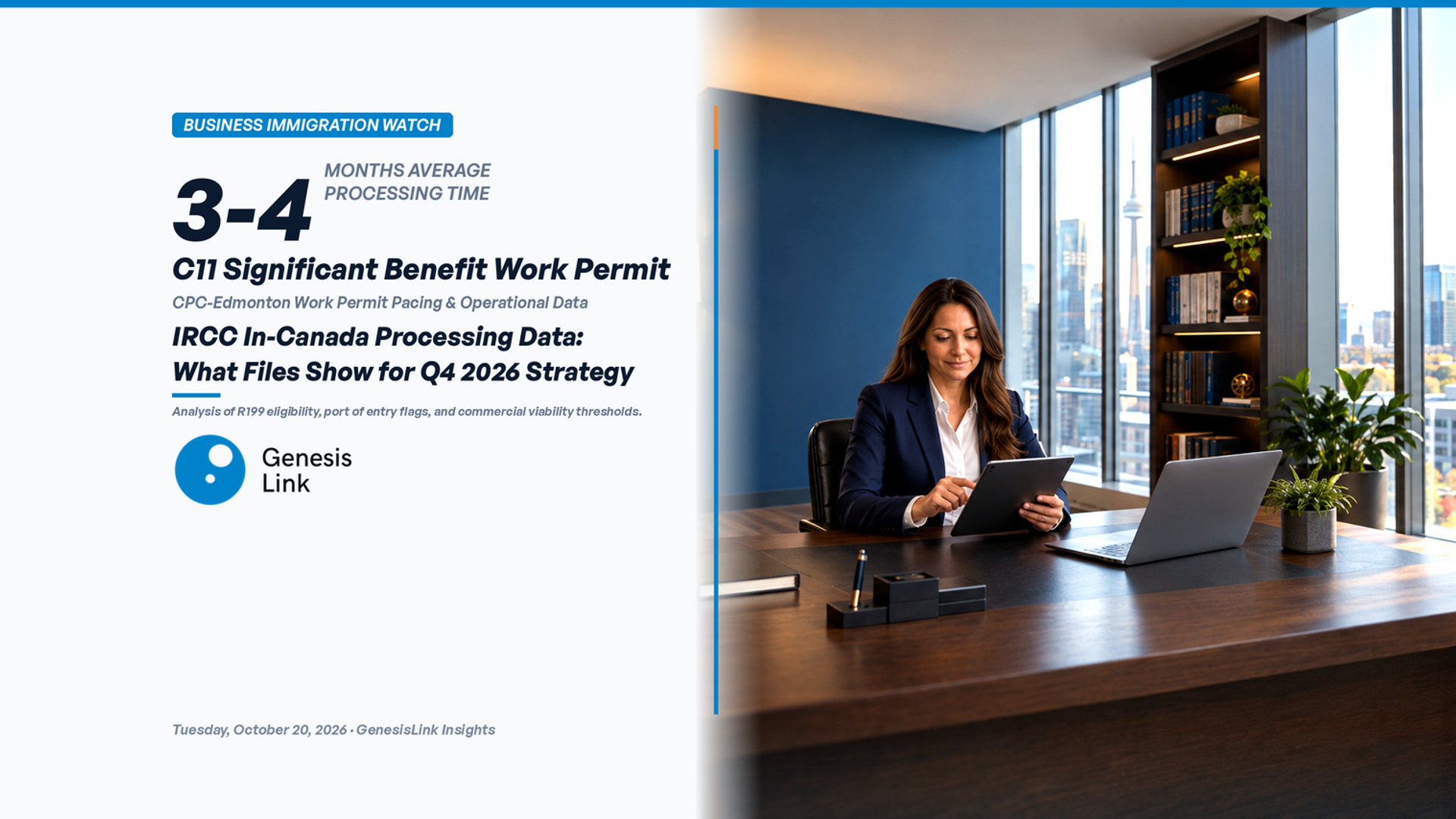
C11 Work Permit Processing Times in Canada: What Q4 2026 Adjudication Trends Show
An analysis of in-Canada C11 work permit processing times at CPC-Edmonton for Q4 2026. Practical data on IRPR R199 eligibility, adjudication timelines, and commercial viability standards for immigration professionals.
60-Second Key Takeaways for Immigration Counsel
- Current CPC-Edmonton Pacing: In-Canada C11 initial applications under IRPR R199 and renewal applications are averaging 106 to 124 calendar days (~3.5 to 4 months) as of mid-October 2026.
- R199 Strict Scrutiny: IRCC inland processing units are systematically reviewing applicant status validity at filing. Changing status from visitor or worker requires clean documentary proof of eligibility prior to submission.
- Operating Capital Verification: Adjudicators are scrutinizing Canadian bank statements to verify unencumbered liquid operating capital before issuing initial 12-month C11 work permits.
- Flagpoling & Border Tightening: With Canada Border Services Agency (CBSA) limiting port-of-entry business work permit processing across Ontario and Quebec land crossings, CPC-Edmonton online filings remain the primary defensible pathway.
Temporary residence processing queues across Immigration, Refugees and Citizenship Canada (IRCC) reflect significant structural realignment as Canada approaches the rollout of the 2027-2029 Immigration Levels Plan. For corporate immigration lawyers and Regulated Canadian Immigration Consultants (RCICs) managing foreign entrepreneur files, navigating work permit adjudication timelines requires understanding operational realities inside the Centralized Processing Centre in Edmonton (CPC-Edmonton).
Following the federal pause on the Start-Up Visa (SUV) and ongoing caps across provincial nominee programs, the C11 Significant Benefit Work Permit (LMIA-exemption code C11 under IRPR R205(a)) has become the focal point of federal business immigration. Recent adjudication trends from active applicant files reveal how inland processing units are assessing commercial viability and maintaining compliance.
What Are the Current IRCC Processing Timelines for In-Canada C11 Files?
IRCC published temporary residence data and active practitioner records indicate that in-Canada work permit extensions and new employer-specific filings submitted via the IRCC Secure Network are currently processing within 15 to 18 weeks. While global outside-Canada processing times vary widely depending on the responsible visa office (ranging from 12 weeks in Western Europe to over 38 weeks in specific Middle Eastern and South Asian missions), inland processing has stabilized.
Why Is Port-of-Entry Flagpoling No Longer Recommended?
Historically, foreign business owners from visa-exempt countries occasionally sought immediate work permit issuance directly at a land border Port of Entry (POE). However, operational directives issued by CBSA throughout 2026 have severely curtailed POE business adjudications.
Border officers are explicitly instructed to prioritize commercial cargo and primary traveler screening. Complex C11 files requiring detailed evaluation of ownership structure, capital capitalization, and economic benefit models are frequently turned back or issued administrative directions to apply online via CPC-Edmonton. Attempting to present a 200-page business immigration file at a border crossing introduces needless operational risk for clients.
What Are Inland Adjudicators Evaluating in Business Files?
Analysis of recent procedural fairness letters (PFLs) and officer notes reveals a clear shift in how CPC-Edmonton officers evaluate significant economic benefit. Adjudicators are focusing on operational execution rather than theoretical business plans.
What Our Files Show
Across more than 300 client files supported alongside immigration counsel, GenesisLink observes that initial C11 approvals in Q4 2026 consistently possess three distinct attributes: unencumbered capital already deposited into a Canadian chartered bank account (minimum $100,000 to $150,000 CAD), an executed commercial lease or registered facility agreement, and verified recruitment efforts targeting Canadian citizens or permanent residents.
1. Liquid Operating Capital on Deposit
Officers want to see that capital is not merely promised or held in offshore accounts. Statements from Canadian financial institutions proving that funds have cleared and are available for commercial operational expenditure are essential to passing officer credibility thresholds.
2. Active Steps Taken Toward Implementation
Under IRCC operational guidelines, an applicant must demonstrate that the business is viable and that active steps have been taken to advance the enterprise. Securing vendor contracts, registering federal or provincial business entities, obtaining municipal business licenses, and securing appropriate insurance show officers that the applicant is prepared to operate immediately upon work permit issuance.
3. Defensible Job Creation Models
Generic promises of hiring five or ten employees are viewed sceptically by inland adjudicators. Economic models must clearly articulate specific National Occupational Classification (NOC) TEER codes, realistic prevailing median wage structures in the local economic region, and clear hiring timelines tied to milestone revenue generation.
How Immigration Professionals Should Structure Q4 2026 Submissions
As the final quarter of 2026 unfolds, practitioners can protect client timelines by following structured filing protocols:
- Audit R199 Eligibility Early: Ensure that foreign nationals currently in Canada hold valid status and qualify under the specific provisions of Section 199 before selecting the in-Canada processing queue.
- Anticipate Maintained Status Windows: For C11 extensions, ensure applications are registered prior to work permit expiry to preserve authorization to work under IRPR R186(u) while CPC-Edmonton completes review.
- Provide Clear Financial Backing: Pair the immigration business plan with verified banking documentation and cash flow projections that align precisely with commercial operations.
GenesisLink collaborates directly with RCICs and immigration law firms across Canada to build defensible, practitioner-grade business cases and compliance frameworks. Counsel manages the legal file and IRCC submissions, while GenesisLink delivers the commercial viability architecture that satisfies officer scrutiny.
Recent News

 October 20, 2026


More on Federal work permits
 BlogC11 Business Plan Requirements: What IRCC Officers Audit in 2026
 BlogC11 Significant Benefit Work Permit Canada: 2026 Legal & Business Architecture Guide
 NewsSmall Business Week 2026: Federal & Regional Capital Windows Open for Canadian SMEs
 NewsC11 Work Permit Processing Times Inside Canada: Adjudication Benchmarks & Operational Guidance (2026)
 NewsC11 Work Permit: Controlling Interest and Corporate Equity Rules (2026)
Discussion
Be the first to comment.
Add a comment