


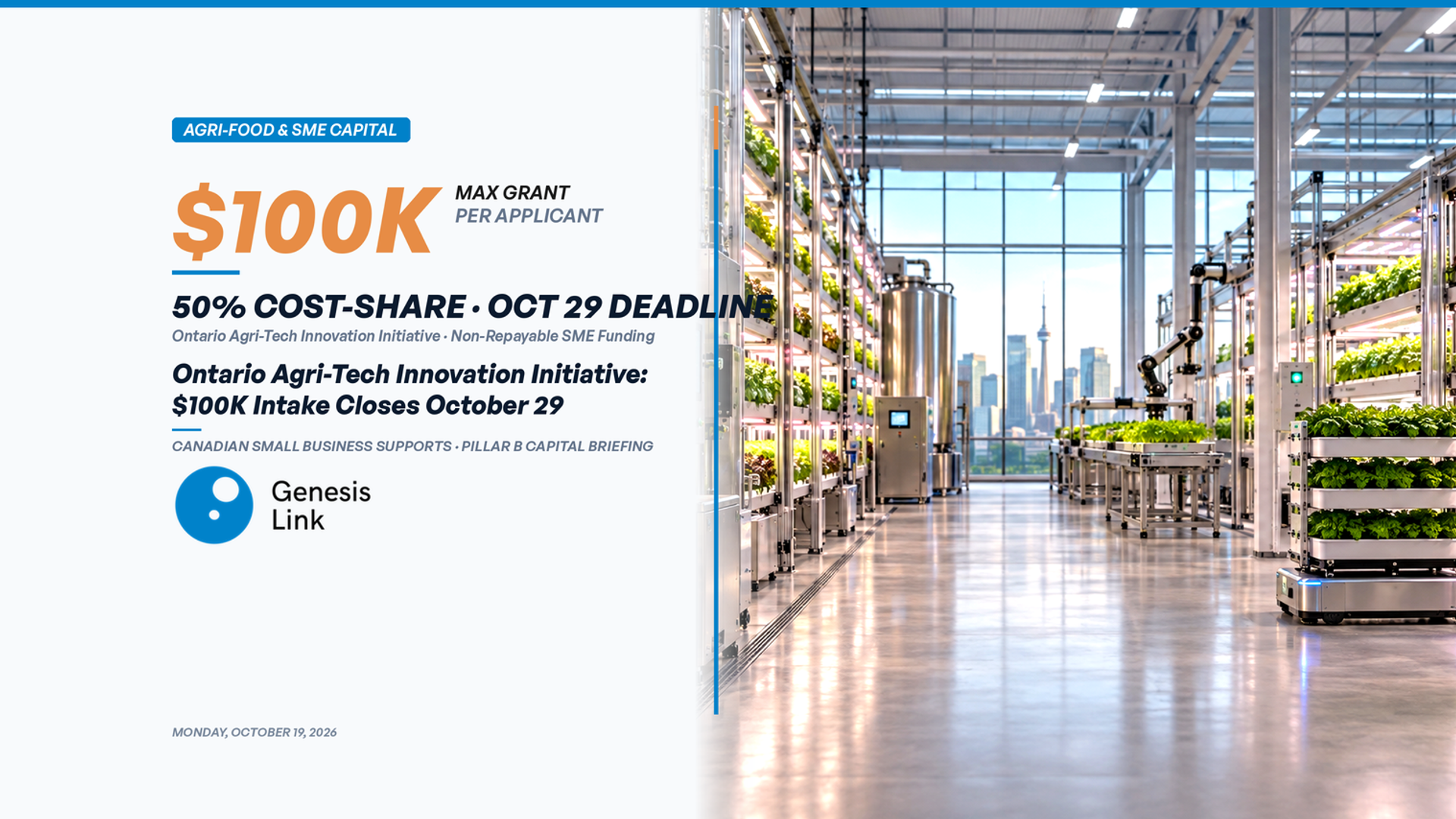
Ontario Agri-Tech Innovation Initiative: $100K Equipment & Technology Intake Closes October 29
Ontario agri-food processors and commercial producers face an October 29, 2026 deadline for up to $100,000 in 50% cost-share non-repayable grant funding under the Sustainable CAP Agri-Tech Innovation Initiative.
60-Second Key Takeaways for Canadian SMEs and Corporate Counsel
- Intake Window: Open under the Sustainable Canadian Agricultural Partnership; applications close on October 29, 2026 at 11:59 PM EDT.
- Funding Cap and Structure: Up to $100,000 in non-repayable grant funding per eligible business entity, delivered as a 50% cost-share reimbursement.
- Eligible Capital Outlays: Advanced sensor systems, automated sorting and packaging robotics, controlled-environment technology, and energy-efficient processing equipment.
- Beneficiary Scope: Established Ontario agri-food processors and commercial greenhouse operations, including qualifying foreign-investor-backed enterprises established via C11, ICT, or provincial streams.
- Strategic Readiness: Applications require firm unexpired vendor quotes, defined commercial productivity metrics, operational labour-impact models, and verified financing for the 50% matching cost-share.
What Is the Ontario Agri-Tech Innovation Initiative?
The Ontario Agri-Tech Innovation Initiative is a targeted cost-shared capital support stream delivered under the federal-provincial Sustainable Canadian Agricultural Partnership. Administered through the Ontario Ministry of Agriculture, Food and Rural Affairs alongside delivery partners, the programme provides direct financial incentives to accelerate the adoption of advanced automation and clean manufacturing technologies across Ontario's agri-food sector.
Unlike theoretical feasibility studies or exploratory research grants, this initiative focuses directly on commercial execution. It reimburses 50% of eligible capital expenses up to a maximum contribution of $100,000 per legal operating entity. Approved projects must directly increase operational throughput, mitigate structural labour constraints, or expand domestic food processing capabilities.
Who Qualifies for Funding?
Eligibility is restricted to commercial enterprises with active physical processing or growing operations in the Province of Ontario. Primary qualifying categories include:
- Food and Beverage Processors: Businesses transforming agricultural commodities into finished consumer or industrial food products with active provincial or federal public health registrations.
- Controlled-Environment Commercial Growers: Advanced commercial greenhouse operators, indoor vertical farms, and hydroponic facilities supplying wholesale or retail distribution channels.
- Agricultural Service and Packing Facilities: Centralised post-harvest grading, packing, cold storage, and bio-industrial processing entities operating within Ontario agricultural zones.
What Expenses Are Eligible and Ineligible?
The programme enforces strict boundaries regarding expenditure categories. Capital investments must directly introduce technological innovation rather than routine operational maintenance.
- Eligible Capital Investments: Optical sorting lines, automated packaging robotics, precision climate sensing networks, clean-in-place sanitation systems, and direct contractor installation fees.
- Ineligible Expenditures: Routine maintenance, replacement of functional machinery with identical models, land or building acquisition, internal employee payroll, marketing campaigns, and ongoing working capital.
What Our Files Show: Strategic Intersection with Newcomer Operators
Across GenesisLink's portfolio of more than 300 client files, agricultural processing and controlled-environment food production represent a rapidly growing focus for entrepreneurs entering Canada through C11 significant benefit work permits and provincial business streams. In many files, foreign entrepreneurs commit substantial personal equity into acquiring Ontario manufacturing or greenhouse assets. Accessing non-dilutive provincial capital such as the Agri-Tech Innovation Initiative achieves two vital outcomes: it reduces early-stage commercial risk by offsetting high capital expenditures, and it provides concrete documentation of third-party government endorsement that reinforces operational legitimacy during federal work permit extensions and permanent residency transitions.
Advisor Action Plan: How to Package Applications Ahead of October 29
With the intake window closing soon, operational teams and corporate advisors must complete documentation promptly:
- Lock Firm Vendor Quotes: Every eligible capital expense must be supported by an itemized, unexpired quote from an arm's-length equipment supplier. Speculative cost estimates are disqualified during initial screening.
- Quantify Productivity Improvements: Reviewers assess applications on measurable efficiency gains. Proposals must clearly demonstrate projected yield increases or labour cost reductions.
- Verify Matching Funds: Applicants must attach verified bank statements or formal financing approval letters demonstrating unencumbered capital sufficient to cover the 50% applicant contribution.
- Finalize Submission Prior to October 29: All digital declarations must be submitted before the portal closes at 11:59 PM EDT on October 29, 2026.
Frequently Asked Questions
Can a federally incorporated business owned by foreign nationals apply?
Yes, provided the operating business is legally registered in Ontario, maintains physical facilities within the province, complies with all Canadian tax and labour laws, and meets all operational agri-food qualification criteria.
Is the $100,000 grant considered taxable business income?
Government assistance for capital equipment purchases typically reduces the capital cost of the acquired depreciable property for tax purposes or must be accounted for according to Canadian Income Tax Act guidelines. Businesses should consult their corporate accounting professionals.
Can projects combine this grant with other federal or provincial programmes?
Sustainable CAP programmes generally permit stacking of public assistance up to 85% of total eligible project costs, though the specific initiative rules stipulate that total government funding cannot exceed specified stacking thresholds.
Are purchases made before application approval eligible for reimbursement?
No. Any costs incurred, deposits paid, or contracts signed prior to the formal programme approval date are strictly ineligible for cost-share reimbursement.
How does GenesisLink assist businesses applying for capital grant streams?
GenesisLink acts as a dedicated business consulting and strategy partner, providing financial modeling, project feasibility narratives, business planning, and documentation frameworks alongside clients' legal and accounting advisors.
Recent News

 October 19, 2026


More on Small business growth
 NewsSmall Business Week 2026: Federal & Regional Capital Windows Open for Canadian SMEs
 NewsBDC Small Business Week 2026: 78% of Canadian SMEs Pivot to Growth Amid High-Speed Market Shifts
 NewsNova Scotia WIPSI Fall 2026 Intake Closes: Up to 100% Training Funding for Canadian SMEs
 NewsFedDev Ontario Expands Regional AI Initiative to $700M: Application Windows Open for Canadian SMEs
 NewsBDC and Woveo Launch $10M Microlending Program for Canadian Small Businesses
Discussion
Be the first to comment.
Add a comment