


IRCC Releases 2026 Express Entry Reforms Consultation Report: Structural Overhaul and Wage-Based Selection
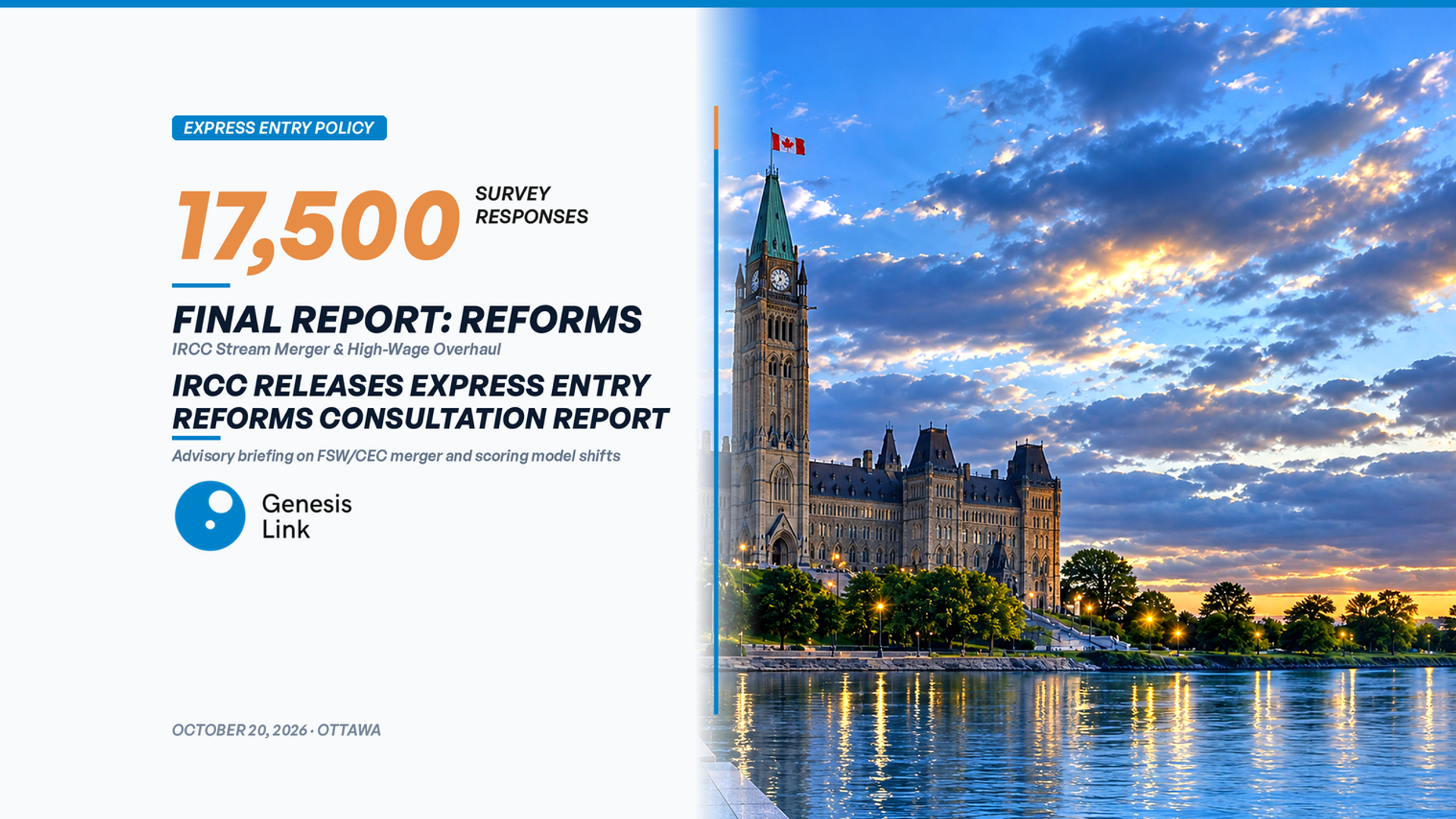
IRCC has published the final report on 2026 Express Entry reforms covering 17,500 survey responses, program consolidation of FSWP and CEC, high-wage selection models, and age scoring recalibration ahead of November 3 changes.
60-Second Executive Summary for Immigration Advisors
- 17,500 Survey Responses & 109 Roundtables: IRCC has concluded its consultation report evaluating structural reforms to Express Entry and the Comprehensive Ranking System (CRS).
- Federal Program Consolidation: Strong institutional consensus supports merging the Federal Skilled Worker Program (FSWP), Canadian Experience Class (CEC), and Federal Skilled Trades Program (FSTP) into a single streamlined economic intake channel.
- Wage-Based CRS Calibration: General stakeholder backing for wage benchmarks (1.3x median threshold) linked directly to the November 3, 2026 LMIA-exemption point system.
- Age Penalty & Canadian Education Recalibration: Substantial feedback urges IRCC to relax CRS age deductions for established mid-career professionals and retain point allocations for degree credentials.
- Strategic Advisory Impact: Counsel must prepare transitional applicants for automatic score recalculations and the November 3 profile update deadline.
Immigration, Refugees and Citizenship Canada (IRCC) has released its official final report summarizing nationwide consultations on proposed structural reforms to Express Entry’s Federal High Skilled programs and the Comprehensive Ranking System (CRS). Drawing from 17,500 public survey respondents, 109 roundtable participants across legal, academic, and employer sectors, and 42 formal institutional submissions, the report outlines the policy roadmap reshaping federal economic selection ahead of the November 3, 2026 regulatory overhaul.
What Are the Core Structural Changes Under Review?
The consultation findings demonstrate widespread support for simplifying Canada's federal economic immigration architecture. The central operational reform under consideration is the consolidation of three legacy economic streams, the Federal Skilled Worker Program (FSWP), Canadian Experience Class (CEC), and Federal Skilled Trades Program (FSTP), into a unified Federal High Skilled intake mechanism.
Under the proposed framework, candidates will enter a single intake pool governed by standardized Minimum Entry Criteria (MEC). While participants supported administrative simplification, immigration counsel and professional bodies emphasized the necessity of maintaining accessible thresholds for skilled trades, where current FSTP standalone intake accounts for minimal direct invitations due to category-based draws.
How Will the Wage-Based Scoring Model Affect File Positioning?
The consultation report directly reinforces the operational direction announced by Minister Lena Metlege Diab on October 16, 2026. Effective November 3, 2026, IRCC is replacing the traditional Labour Market Impact Assessment (LMIA) prerequisite for qualifying job offer points with an objective occupational high-wage assessment.
Under this standard, occupations commanding median earnings at or above 1.3 times the Canadian workforce median will receive premium CRS allocations. This structural realignment heavily advantages experienced executives, senior technical managers, and specialized enterprise operators, demographics central to corporate immigration portfolios and C11 work permit transition strategies.
What Our Files Show: Practitioner Case Analysis
Across more than 300 active business immigration and transitional corporate files managed alongside our legal partners, steep CRS age deductions have historically disqualified experienced foreign owner-operators between ages 35 and 48, despite substantial commercial capitalization in Canada. The integration of high-wage occupational ranking offers a clear compensatory scoring mechanism, allowing business founders and senior transferees with qualifying operational compensation to secure competitive scores without relying on contentious LMIA filings.
What Concerns Were Raised Regarding Age Penalties and Education?
A primary friction point highlighted across written briefs and roundtable discussions was the current CRS age distribution curve. Stakeholders repeatedly noted that deducting 5 points per year after age 29 severely penalizes mid-career professionals, entrepreneurs, and senior executives who possess precisely the managerial acumen and financial stability needed to drive domestic productivity.
Furthermore, participants urged the Department to retain dedicated educational credential points for Canadian post-secondary graduates at the Bachelor's level and above, cautioning against broad point reductions that could undermine talent retention across technology and research clusters.
What Immediate Steps Must Practitioners Take Before November 3?
With Express Entry invitation rounds temporarily paused while IRCC recalibrates pool algorithms, counsel should implement the following compliance measures across active client rosters:
- Audit Qualifying Job Offers: Review existing client employment contracts against IRCC's official High-Wage Occupation schedule to confirm eligibility for the 1.3x median benchmark.
- Mandatory Profile Updates: Ensure eligible candidates update their Express Entry profiles with verified occupational and compensation data prior to the November 3 recalculation cutoff.
- Evaluate Business Pathway Transitions: For business owners operating on C11 significant benefit work permits or intra-company transfers, prepare documented commercial evidence and payroll structures establishing genuine executive remuneration.
- Monitor Post-Recalibration Cutoffs: Track emerging CRS score distributions once bi-weekly invitation draws resume in mid-November to establish updated invitation thresholds for high-skilled and business cohorts.
As the federal selection system shifts toward verifiable economic contribution and wage metrics, structuring credible, compliant business operations remains essential for long-term permanent residence pathways.
Recent News

 October 19, 2026


More on Express Entry & PR
 NewsIRCC Announces Imminent Express Entry Changes: Minister Briefing Scheduled for October 16
 NewsExpress Entry Draw #447: 3,500 Trades ITAs at CRS 476 (October 1, 2026)
 NewsExpress Entry CEC Draw 439 Confirmed: 2,000 ITAs at CRS 521-1 September 2026
 NewsBusiness Immigration Policy Watch August 21 2026, Capacity Before Capital
 NewsExpress Entry French Draw #437, August 19, 2026: 5,000 ITAs at CRS 382
Discussion
Be the first to comment.
Add a comment