


US 50% Tariffs on Canada. What Advisors on Active C11, ICT, and PNP Files Need to Know
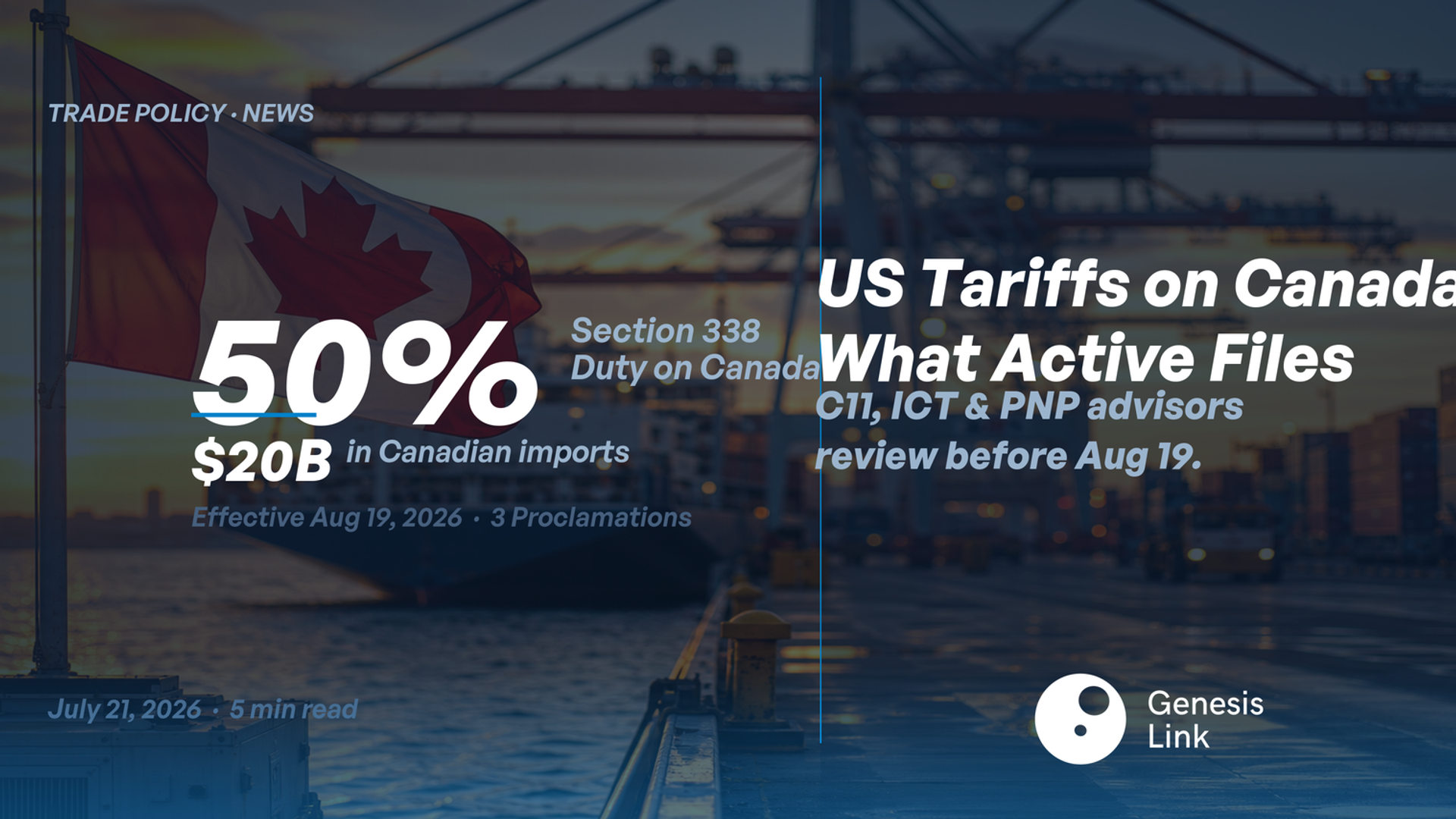
On July 20, 2026, the US imposed 50% Section 338 tariffs on nearly $20 billion in Canadian imports, effective August 19. Here is what RCICs and advisors with active C11, ICT, and PNP entrepreneur files need to review now.
Key Takeaways
- On July 20, 2026, the US government issued three Section 338 proclamations imposing 50% tariffs on nearly $20 billion in Canadian imports.
- Tariffs take effect August 19, 2026. A 30-day window exists to review and update active immigration business files.
- Covered categories include dairy, alcoholic beverages, and motor vehicles. Product lists extend beyond those headings to consumer goods, cement, and more.
- USMCA-qualifying goods are not exempt from these Section 338 duties.
- C11, ICT, and PNP entrepreneur files embedding US market revenue assumptions need immediate review.
In this article: What changed on July 20 · Effective date and 30-day window · Which immigration files are most exposed · What files need repositioning · Practical recommendations for advisors
On July 20, 2026, the US government issued three proclamations under Section 338 of the Tariff Act of 1930. Each targets a distinct Canadian trade measure. The combined effect: a 50% ad valorem duty on nearly $20 billion in Canadian imports, effective August 19, 2026.
The three covered product categories are dairy, alcoholic beverages, and motor vehicles. Product lists extend beyond those headings. The White House confirmed covered goods include items ranging from wine to cement to hockey sticks. Energy, potash, fish, critical minerals, and products already subject to Section 232 duties are excluded.
One critical detail for advisors: USMCA status does not provide an exemption. A Canadian product can qualify as originating under the trade agreement and still face the full 50% Section 338 duty. This is the first use of Section 338 in the modern trade era. The proclamations carry no scheduled expiration date. Treating this as structural is the right starting point.
The 30-Day Window That Matters for Active Files
The tariffs do not take effect immediately. Entries subject to the duty must be filed on or after 12:01 a.m. Eastern Time on August 19, 2026. That 30-day window is the relevant timeline for immigration professionals. Not for customs filings, but for business documentation review.
Any active C11, ICT, or PNP entrepreneur file projecting US export revenue or incorporating US supply chain assumptions should be reviewed before provincial or federal officers assess it under these new trade conditions. A business plan written in Q2 2026 carried different market assumptions than the same plan assessed in September 2026.
Which Immigration Files Are Most Exposed
C11 owner-operator files. The significant benefit test under R205(a) requires demonstrating sustained economic contribution to Canada. Owner-operators running businesses that export to the US. In covered product categories. Now face a material shift in their revenue model. An updated financial plan addendum is worth preparing before the file reaches an officer. See our full breakdown at C11 Owner-Operator Canada 2026.
ICT files. New entity and established entity. Multinational companies using the ICT pathway to establish or expand Canadian operations need to assess whether the tariffs affect their cross-border operational rationale. The operational commencement and compensation capacity elements of a new-entity ICT file are harder to demonstrate if the parent company's US-Canada trade flows are significantly disrupted. Counterpoint: a company pivoting to serve the Canadian market domestically. Rather than relying on cross-border flows. May have a stronger ICT business case today than six months ago. Full ICT requirements at ICT Intra-Company Transfer Canada 2026 Guide.
PNP entrepreneur files. BC PNP, AAIP, and SINP officers examine business plan viability at both Stage 1 and Stage 2. A business plan projecting US market revenue from affected product categories. Without addressing the post-August 19 duty structure. Will raise questions at provincial review. For any files with Stage 2 reviews scheduled between August and October 2026, a financial plan update is the practical move.
For Advisors and Entrepreneurs on Active Files
- Flag any C11 or PNP files projecting US export revenue from dairy, beverages, automotive components, or consumer goods.
- For ICT new-entity files, confirm the Canadian entity's operational rationale holds under the revised trade environment.
- For PNP Stage 2 reviews scheduled August. October 2026, consider a financial plan addendum noting the tariff context.
- Treat updated documentation as a credibility signal. Proactive acknowledgement of market conditions strengthens any business case.
What This Means for the Business Immigration Landscape
The US-Canada trade environment has shifted significantly since early 2025. The July 20 Section 338 proclamations mark a new phase. Targeted sector-by-sector duties with no expiration date. That pattern signals structural change, not a temporary negotiating position.
For business immigration advisors, this aligns with a broader pattern we see across C11 and ICT files. US-based companies establishing Canadian operations to serve the domestic Canadian market. Without the cost burden of cross-border flows. Have a stronger operational rationale today than 12 months ago. That rationale feeds directly into ICT business plan viability at the new-entity stage.
The firms and advisors who update their clients' documentation now will enter provincial and federal reviews with business plans that reflect current market conditions, not Q2 2026 assumptions. For a full overview of active business immigration pathways in this environment, see our Canada Business Immigration Complete Guide 2026.
GenesisLink supports RCICs and immigration lawyers with the business documentation side of C11, ICT, and PNP entrepreneur files. If you have active files with US market exposure, book a file review call or run a preliminary assessment at assessment.genesislink.ca.
Related Reads
- C11 Owner-Operator Canada 2026: What Officers Assess
- ICT Intra-Company Transfer Canada 2026 Guide
- Canada Business Immigration Complete Guide 2026
Frequently Asked Questions
Do the US 50% tariffs on Canada affect my ability to get a C11 work permit?
The tariffs do not change IRCC's assessment criteria for C11 work permits under R205(a). They do affect the business environment in which your file is assessed. If your business plan projects US export revenue from covered product categories, your financial assumptions may appear inconsistent with current market conditions when reviewed after August 19, 2026.
What should my RCIC do if my immigration business plan includes US export revenue?
That is a business documentation decision. If your business plan was written before July 2026 and includes US market revenue assumptions, a review of the financial model is worth prioritising now. Business plans are assessed against the market conditions at the time of review. An officer seeing a September 2026 date on a file will expect it to reflect current trade conditions.
Which Canadian business sectors are excluded from the 50% Section 338 tariffs?
Energy products, potash, fish, critical minerals, and products already subject to Section 232 duties are excluded from the new levies. The product lists are defined by Harmonized Tariff Schedule provisions. The categories extend well beyond dairy, beverages, and vehicles, so a line-by-line product review is the only reliable approach for any specific goods.
Does USMCA status exempt a Canadian product from the new tariffs?
No. USMCA-qualifying goods are explicitly subject to the 50% Section 338 duty. The proclamations confirm that covered goods remain subject to these tariffs even when they qualify for preferential USMCA treatment. This is a common misreading of the announcement.
How do the US tariffs affect PNP entrepreneur business plan reviews at Stage 2?
Provincial officers assess business plan viability at both Stage 1 and Stage 2 reviews. A business plan that projects US export revenue without acknowledging the post-August 19 tariff structure may raise credibility questions at Stage 2. Advisors with clients in Stage 2 reviews scheduled for August. October 2026 should consider whether a financial addendum is warranted.
Recent News

 October 19, 2026

More on Provincial programs (PNP)
 NewsExpress Entry CEC Draw 439 Confirmed: 2,000 ITAs at CRS 521-1 September 2026
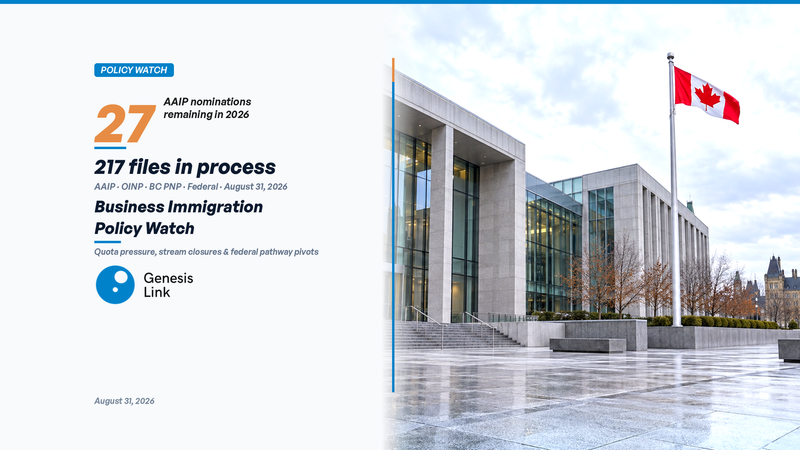 NewsBusiness Immigration Policy Watch, August 31, 2026
 BlogBusiness Immigration File Review Insights August 2026: 3 Practitioner Patterns in C11, ICT, and BC PNP Applications
 BlogCanada Business Immigration News August 2026: Provincial Stream Allocations & Federal Pathway Calibration
 NewsBusiness Immigration Policy Watch August 21 2026, Capacity Before Capital
Discussion
Be the first to comment.
Add a comment