


Carney Signals a "Controlled Increase" in Population Ahead of the 2027-2029 Levels Plan
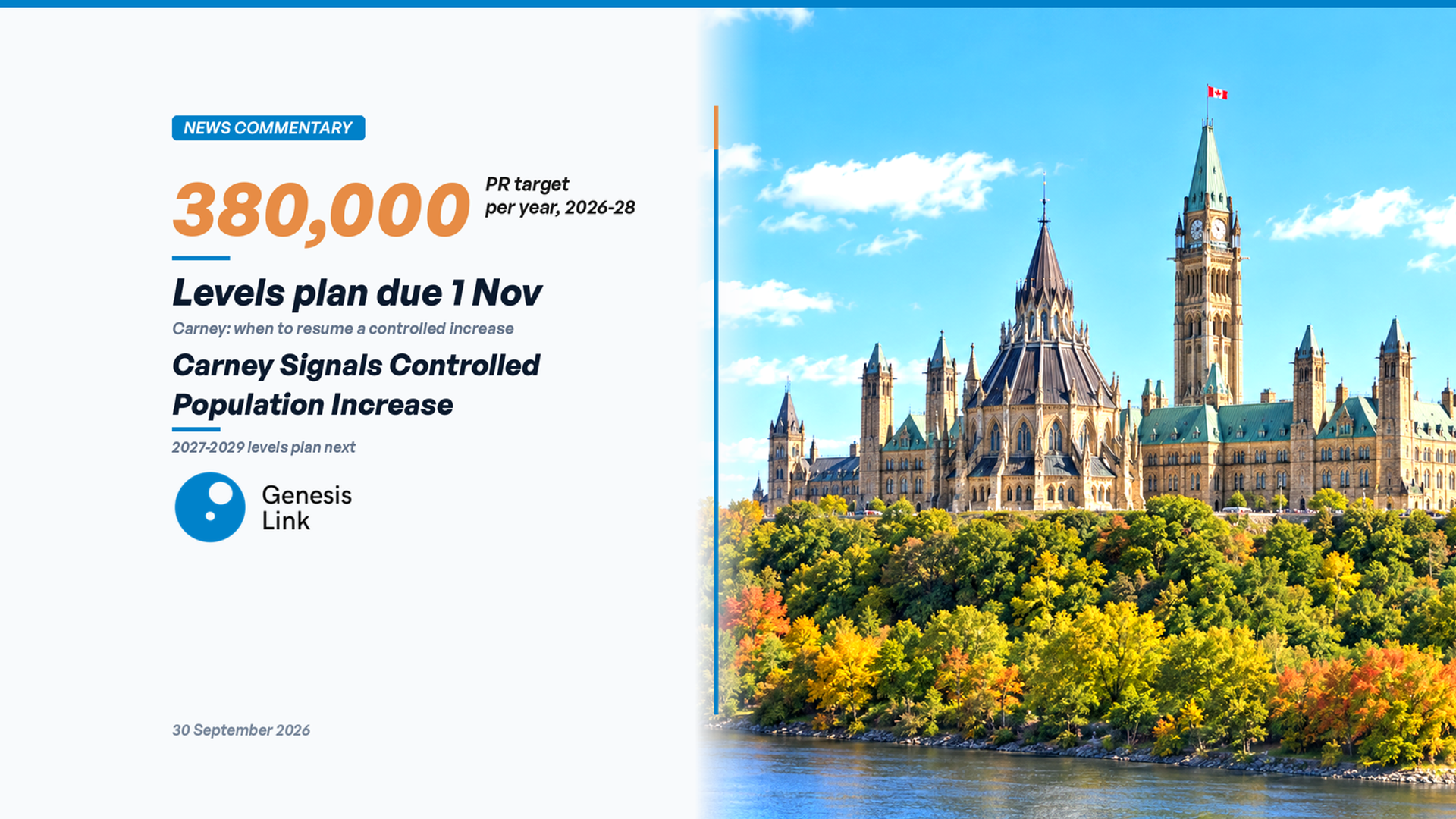
Prime Minister Mark Carney says the question is now when to resume a controlled increase in Canada's population. What is known, what is not, and what advisors should watch before the 2027-2029 levels plan.
By Sajad Bahramian, Marketing and Sales Lead, GenesisLink
What the Prime Minister said
Prime Minister Mark Carney told the New York Times in an interview on 23 September that, with Canada’s immigration system back under control, the question is now timing. In his words: “Now the question starts to become, when do we resume some controlled increase in the population, which is the nature of Canada? So that will happen, and we just want to make sure that we’ve got it under control.”
The interview was reported widely on 29 and 30 September. It comes just over a month before the government must publish its next immigration levels plan, which covers 2027 to 2029. By law that plan is due on 1 November, which falls on a Sunday this year, so a grace period applies until Parliament sits.
What the government has said since
A spokesperson for Immigration Minister Lena Diab said the Prime Minister was citing large declines in new student and temporary worker arrivals. Carney’s own figures in the interview were a 60% decline in student arrivals, a 50% decline in temporary foreign workers and a one-third decline in asylum seekers on a flow basis.
Asked whether an increase is planned this year, the minister’s office said the 2027-2029 plan will “ensure immigration remains at sustainable levels.” No numbers have been announced, and the current targets remain in force.
The numbers in play
- Permanent resident targets in the 2026-2028 plan: 380,000 in each of 2026, 2027 and 2028
- Temporary resident arrival targets in the same plan: 385,000 in 2026; 370,000 in each of 2027 and 2028
- Additional temporary measures (outside the main plan): About 148,000 permanent residents over two years
- Non-permanent residents, share of population (1 July): 6.7%, against a goal of 5% by the end of 2027
- Population growth, year over year (1 July): 0.5%
- C.D. Howe immigration targets council recommendation: 380,000 in 2027; 350,000 in 2028; 340,000 in 2029
Plan targets are from the IRCC 2026-2028 Immigration Levels Plan on canada.ca. Population, non-permanent resident and C.D. Howe figures come from reporting by The Canadian Press and the Benefits and Pensions Monitor. Confirm all figures against the 2027-2029 plan when it is tabled.
Reactions
The responses split along familiar lines. The Conservative immigration critic said levels need to go down, not up. The C.D. Howe council recommends continued gradual reductions in permanent resident admissions, with a steadier rate linked to a share of population. Council member Mikal Skuterud cautioned against using immigration to address a tight labour market and pointed out that the 6.7% non-permanent resident share makes the 5% target hard to reach.
What this means for advisors
A comment in an interview is a direction signal. It is not a policy change, and no programme rules, allocations or processing priorities have moved. Three points are useful for file planning.
1. The levels plan is the next real data point. The tabled plan will show whether economic-class admissions, and any business-linked streams within them, change for 2027 to 2029. Advisors with clients weighing a 2027 or 2028 filing should revisit timelines after it is published.
2. A growth signal favours prepared files. If targets rise later, demand will follow. Clients with a documented business plan, financial model and market evidence in hand will be positioned to move when windows open, regardless of which stream they choose.
3. The temporary-resident target still shapes work permits. The government is aiming to reduce the non-permanent resident share to 5%. Work permit routes that depend on a business case, such as C11 and provincial nominee work permits, continue to be assessed on the substance of the file. The Start-Up Visa Program has been paused since 30 June 2026, and IRCC continues to process applications accepted before that date.
How GenesisLink reads this
We support RCICs and immigration lawyers on the business side of files. Across 300+ client files and 20+ RCIC partners, the pattern we see is that policy signals move faster than file readiness. Advisors who build the business case early are not forced to rush when an opening appears. This is a planning observation from our file work and does not replace your legal analysis.
Practitioner action plan
- Mark 1 November on your calendar and plan a client update once the levels plan is tabled.
- Sort your caseload by earliest realistic filing date and identify which files need business plan work now.
- Keep client expectations factual: no new targets have been announced.
- Watch for economic-class and provincial allocation changes in the plan, not only the headline total.
- Review your onward pathway notes for each C11 and provincial nominee client.
Frequently asked questions
Has Canada announced an increase in immigration levels? No. The Prime Minister said the question is when to resume a controlled increase. The minister’s office said the 2027-2029 plan will keep immigration at sustainable levels. No new targets have been published.
When is the next immigration levels plan due? By law the plan must be published by 1 November. That date is a Sunday this year, so a grace period applies if Parliament is not sitting.
What are the current permanent resident targets? The 2026-2028 plan sets permanent resident targets of 380,000 in each of 2026, 2027 and 2028. Its temporary resident arrival targets are 385,000 in 2026 and 370,000 in 2027 and 2028. Reporting also cites about 148,000 additional permanent resident admissions from two temporary measures outside the main plan. Note that some press coverage attributes the 385,000 and 370,000 figures to permanent residents, but the plan assigns them to temporary arrivals.
Does this change C11 or provincial nominee work permit processing? Nothing has been announced that changes either route. Watch the levels plan and IRCC programme delivery updates for changes.
Does GenesisLink give legal or immigration advice? No. GenesisLink is a business consulting firm. We build the business plans, financial models and documentation that support files prepared by RCICs and immigration lawyers.
Work with GenesisLink
If you want a second set of eyes on the business side of a file before the levels plan lands, our team can help.
- Start an assessment: https://assessment.genesislink.ca/assessment
- Book a call: https://calendar.app.google/ZJHHvvpjbFnWtA7EA
Sources: The Canadian Press (29 September 2026), Benefits and Pensions Monitor (30 September 2026), statements attributed to the Prime Minister in a New York Times interview on 23 September 2026.
Discussion
Be the first to comment.
Add a comment