


IRCC Overhauls Express Entry: High-Wage CRS Changes and LMIA Removal Effective November 3, 2026
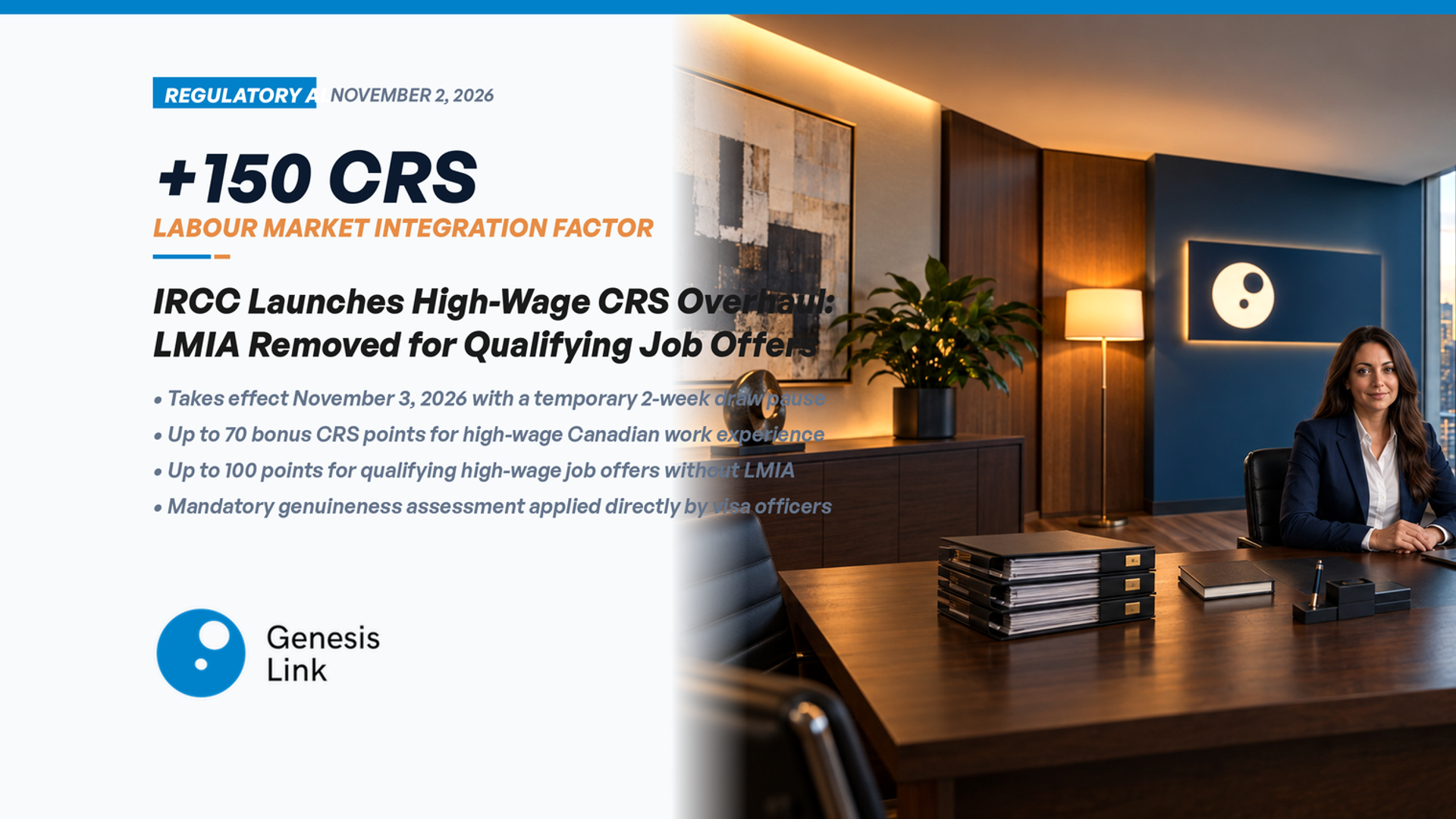
IRCC announces sweeping Express Entry changes effective November 3, 2026, launching the Labour Market Integration factor with up to 150 points and removing LMIA requirements for high-wage job offers.
60-Second Key Takeaways for Immigration Practitioners
- November 3, 2026 Launch: IRCC has introduced the Labour Market Integration factor under the Comprehensive Ranking System (CRS), replacing legacy points structures and triggering an immediate two-week freeze on invitation rounds while pool profiles recalculate.
- 150 Maximum CRS Points: Candidates are awarded either high-wage Canadian work experience points (up to 70 bonus points on top of work-length) or a qualifying high-wage job offer (up to 100 points), calculated on whichever provides the higher score.
- LMIA Requirement Removed: Qualifying job offers no longer require a Labour Market Impact Assessment (LMIA) for CRS points or program eligibility, eliminating months of ESDC processing for qualifying high-wage roles.
- Substantive Genuineness Review: In place of ESDC paper processing, IRCC visa officers now directly assess business viability, commercial logic, employer financial capacity, and genuine operational need.
Immigration, Refugees and Citizenship Canada (IRCC) has announced one of the most consequential structural overhauls to the Express Entry Comprehensive Ranking System (CRS) since the introduction of category-based selection. Effective November 3, 2026, IRCC is replacing the traditional points allocation model with the newly minted Labour Market Integration factor, formalizing substantial advantages for high-wage managerial, professional, and corporate candidates.
To implement the recalculation across all active profiles in the Express Entry pool, IRCC has paused all rounds of invitations for up to two weeks. Regular invitation draws are scheduled to resume once system-wide scoring updates conclude.
Understanding the Labour Market Integration Factor
The new factor introduces a bifurcated scoring mechanism capped at 150 points. Under the revised framework, Express Entry profiles receive points from either Canadian work experience or a qualifying job offer, whichever yields the superior total:
- Canadian Work Experience: Combines established work-length points (up to 70 points with spouse, 80 points without) with newly introduced high-wage occupation bonus points (up to 70 points), reaching a combined maximum of 140 to 150 points.
- Qualifying Job Offer: Awards up to 100 points based strictly on the occupational median wage ratio, completely independent of an LMIA.
High-Wage Occupation Tiers and Points Breakdown
Under IRCC's updated operational criteria, an occupation qualifies as "high-wage" when the median wage across Canada for its National Occupational Classification (NOC) code equals or exceeds 1.3 times the Canadian workforce median wage. Scoring operates on a three-tier sliding scale:
The End of LMIA Dependency: What This Means for Business Files
For years, business owners, senior executives, and transferring corporate professionals were hindered by LMIA requirements administered by Employment and Social Development Canada (ESDC). The November 3 directive explicitly removes the LMIA requirement for Express Entry job offer points and program eligibility in high-wage occupations. Having an LMIA will no longer provide additional points or priority standing.
Instead, authority shifts directly to IRCC visa officers assessing permanent residence applications. Officers must determine whether an offer is genuine, scrutinizing:
- Whether the hiring enterprise is actively engaged in ongoing commercial operations.
- Whether the employer possesses verifiable payroll and balance sheet capacity to fulfill compensation commitments.
- Whether the role corresponds to legitimate operational demands rather than artificial profile creation.
- Whether the candidate demonstrates the executive competence, specialized knowledge, and background required for the position.
What Our Files Show: Business Viability Is Now the Primary Defence
Across more than 300 business immigration and corporate structuring files managed by GenesisLink in partnership with licensed RCICs and immigration counsel, the removal of third-party administrative hurdles invariably elevates the rigor of officer-level review. Applications that previously relied on formal LMIA certificates will now face direct forensic examination of employer legitimacy, financial filings, organizational charts, and corporate tax accounts. Structured documentation proving legitimate enterprise operations is no longer optional; it is the determinative factor in permanent residence approval.
Immediate Practitioner Action Plan
- Audit Existing Pool Profiles: Re-calculate CRS standings for corporate clients, intra-company transferees (C61/C62/C63), and C11 owner-operators. Candidates currently holding managerial positions at high wage tiers stand to gain 20 to 100 points upon system recalculation.
- Implement Interim Profile Settings: IRCC has instructed candidates with non-LMIA high-wage offers to input a standardized placeholder in their profile ("LMIA Number: 00000", issuance "2026-01-01", expiry "2029-01-01") until front-end interface updates are deployed.
- Upgrade Corporate Evidence Packages: Ensure employer business documentation, including audited financials, GST/HST filings, premises lease commitments, and commercial contracts, is fully compiled prior to ITA issuance.
Recent News

 November 2, 2026


More on Federal work permits
 NewsIRCC Announces Imminent Express Entry Changes: Minister Briefing Scheduled for October 16
 NewsExpress Entry CEC Draw 439 Confirmed: 2,000 ITAs at CRS 521-1 September 2026
 NewsBusiness Immigration Policy Watch August 21 2026, Capacity Before Capital
 NewsExpress Entry French Draw #437, August 19, 2026: 5,000 ITAs at CRS 382
 NewsExpress Entry 2027 Category Consultation, What Business Immigration Files Need by September 1, 2026
Discussion
Be the first to comment.
Add a comment