


Express Entry French Draw #450: 5,000 ITAs Issued as Cut-Off Reaches 435
IRCC issued 5,000 ITAs in Express Entry French Draw #450 at CRS 435. Here is the operational analysis for C11 and ICT business operators transitioning to PR.

60-Second Practitioner Summary
- Draw Parameters: On October 16, 2026 at 10:25:13 UTC, IRCC conducted Express Entry Round #450 under the French-Language Proficiency 2026-Version 2 category, issuing 5,000 Invitations to Apply (ITAs).
- CRS Benchmark: The Comprehensive Ranking System (CRS) minimum cut-off reached 435 points, reflecting an upward movement from earlier 2026 baselines amidst elevated candidate density.
- Strategic Business Nexus: For foreign business owners operating under C11 Significant Benefit and ICT (Intra-Company Transfer) pathways, bilingual capability remains the most reliable fast-track mechanism to permanent residence (PR) outside high-scoring PNP streams.
- November 3 Overhaul Context: Following IRCC's major October 16 policy announcement eliminating 50/200 LMIA job offer points on November 3, 2026, category-based language draws are now established as the primary federal route for transitioning temporary executive operators into permanent status.
What Were the Official Parameters of Express Entry Round #450?
Immigration, Refugees and Citizenship Canada (IRCC) concluded its third major invitation round of the October 13–16 cycle on Friday, October 16, 2026, issuing 5,000 invitations to apply for permanent residence under the dedicated French-language proficiency category.
Round #450 followed a 1,000-ITA Provincial Nominee Program (PNP) round on October 14 (CRS 744) and a 2,500-ITA Canadian Experience Class (CEC) round on October 15 (CRS 519). With 5,000 invitations distributed in a single draw, French proficiency continues to represent IRCC’s highest-volume category mechanism in the 2026 federal immigration architecture.
Why Did the CRS Minimum Score Increase to 435?
While a cut-off score of 435 remains significantly lower than the general Canadian Experience Class floor (519 on October 15) and standard Skilled Worker thresholds (535+), it represents a notable 53-point increase over earlier 2026 French rounds that dipped into the 380s. Two primary factors account for this upward movement:
- Pool Concentration of Bilingual Professionals: As general CRS thresholds remained above 510 throughout 2026, hundreds of skilled professionals and business operators invested in NCLC 7 French language credentials (TEF Canada or TCF Canada) to secure category eligibility.
- Candidate Density in the 400–450 Bracket: IRCC pool data reveals that over 52,000 candidate profiles sit between 401 and 450 points. As more applicants submit verified NCLC 7 test scores, the natural clearing price for 5,000 invitations shifts toward the mid-430s.
What Our Files Show: Executive PR Transition Dynamics
Across 300+ business immigration mandates managed by GenesisLink alongside licensed RCICs and legal counsel, business operators entering Canada on C11 Significant Benefit or ICT work permits frequently face a persistent challenge: age and foreign-degree evaluations cap their base CRS score between 400 and 430. Prior to October 2026, many files relied on corporate LMIA points or PNP entrepreneur nominations. With the November 3, 2026 elimination of LMIA job offer points officially confirmed by Minister Lena Metlege Diab, acquiring NCLC 7 French proficiency is now the single most dependable lever to transition an active C11/ICT business operator to permanent residency without requiring a 600-point provincial nomination.
What Does This Mean for C11 and ICT Business Operators?
For immigration practitioners structuring commercial entry for business founders, Draw #450 provides three vital strategic takeaways:
- Viable Route for Older Business Owners: In standard CEC draws (CRS 519), a 42-year-old entrepreneur loses 50+ age points, making federal selection nearly impossible without a provincial nomination. Under French category draws at CRS 435, an entrepreneur with a completed post-secondary degree, intermediate French, and one year of Canadian management experience comfortably clears the selection bar.
- Expansion Outside Quebec: IRCC's mandate specifically targets French-speaking permanent residents settling in provinces outside Quebec, perfectly aligning with commercial enterprise establishments in Ontario, Alberta, and British Columbia.
- Defense Against Policy Volatility: Category-based invitations are codified under Ministerial Instructions and protected from the November 3 LMIA point cancellations. Business owners who demonstrate active economic establishment while acquiring language competency maintain multiple parallel exit routes to PR.
Frequently Asked Questions for Legal Counsel and RCICs
Q1: What language test benchmark is required to qualify for French category draws? Candidates must achieve a minimum of NCLC 7 (Niveau de compétence linguistique canadien) in all four abilities (reading, writing, listening, speaking) on either the TEF Canada or TCF Canada exams.
Q2: Does an active C11 work permit holder qualify for this category? Yes, provided they meet standard Express Entry eligibility (typically through the Federal Skilled Worker Program or Canadian Experience Class after accumulating 12 months of qualifying full-time corporate work) and possess valid NCLC 7 language results.
Q3: Will the November 3, 2026 LMIA point elimination affect French category draws? No. The November 3 policy reform eliminates the 50 or 200 points awarded for qualifying arranged employment (LMIA). Category-based draws invite candidates directly from the pool based on criteria established by the Minister, meaning candidates who clear 435 through core human capital and bilingual points are unaffected.
Q4: Can business owners in British Columbia or Alberta utilize this pathway? Yes. Category-based French draws are federal and specifically designed to encourage Francophone and bilingual integration in communities across English-speaking Canada.
Q5: How does GenesisLink support counsel on these files? GenesisLink handles the business execution side: developing compliant business plans, validating commercial viability, and tracking operational milestones under C11 and ICT frameworks so that counsel can focus entirely on immigration compliance and candidate profile optimization.
Recent News

 October 18, 2026

More on Federal work permits
 NewsIRCC Overhauls Express Entry: LMIA Eliminated for Job Offers as High-Wage Points Launch
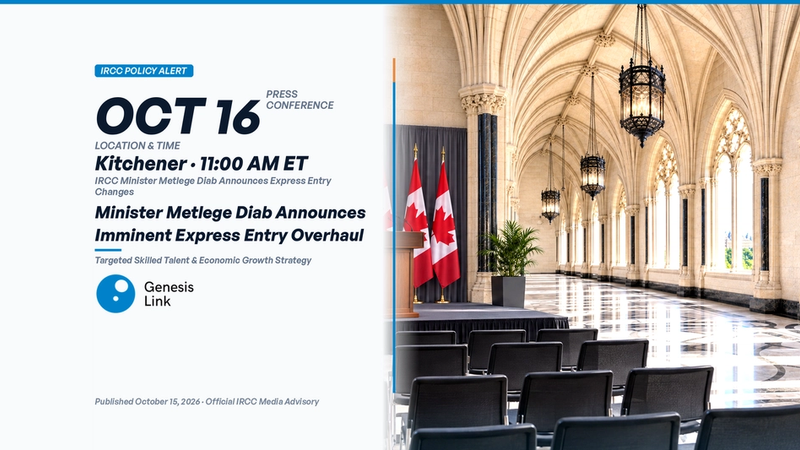 NewsIRCC Announces Imminent Express Entry Changes: Minister Briefing Scheduled for October 16
 BlogExpress Entry Senior Manager Draws: What They Mean for C11, ICT, and SUV Work Permit Holders
 BlogC11 Work Permit to Permanent Residence: Transition Strategies and Evidence Architecture in 2026
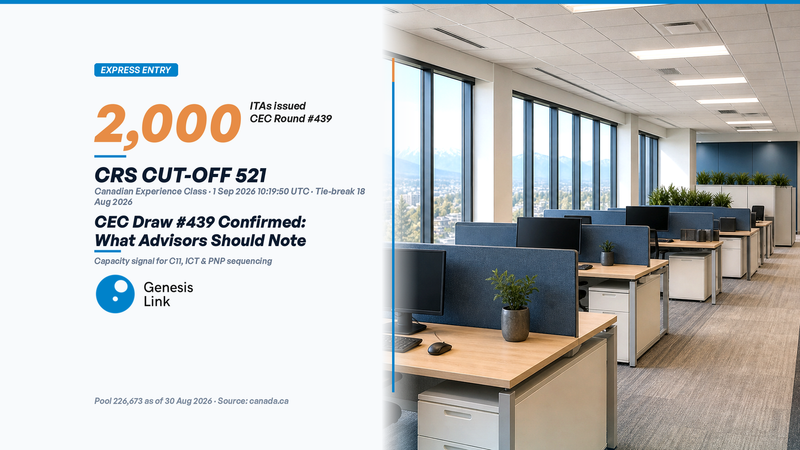 NewsExpress Entry CEC Draw 439 Confirmed: 2,000 ITAs at CRS 521-1 September 2026
Discussion
Be the first to comment.
Add a comment