


ICT Qualifying Relationship and Corporate Substance: IRCC Adjudication Standards in 2026
A practitioner breakdown of IRCC adjudication standards for Intra-Company Transfers (R205(a) C61/C62/C63) in 2026, focusing on foreign parent-subsidiary substance, continuous employment proof, and Canadian office capitalization.
60-Second Practitioner Takeaways
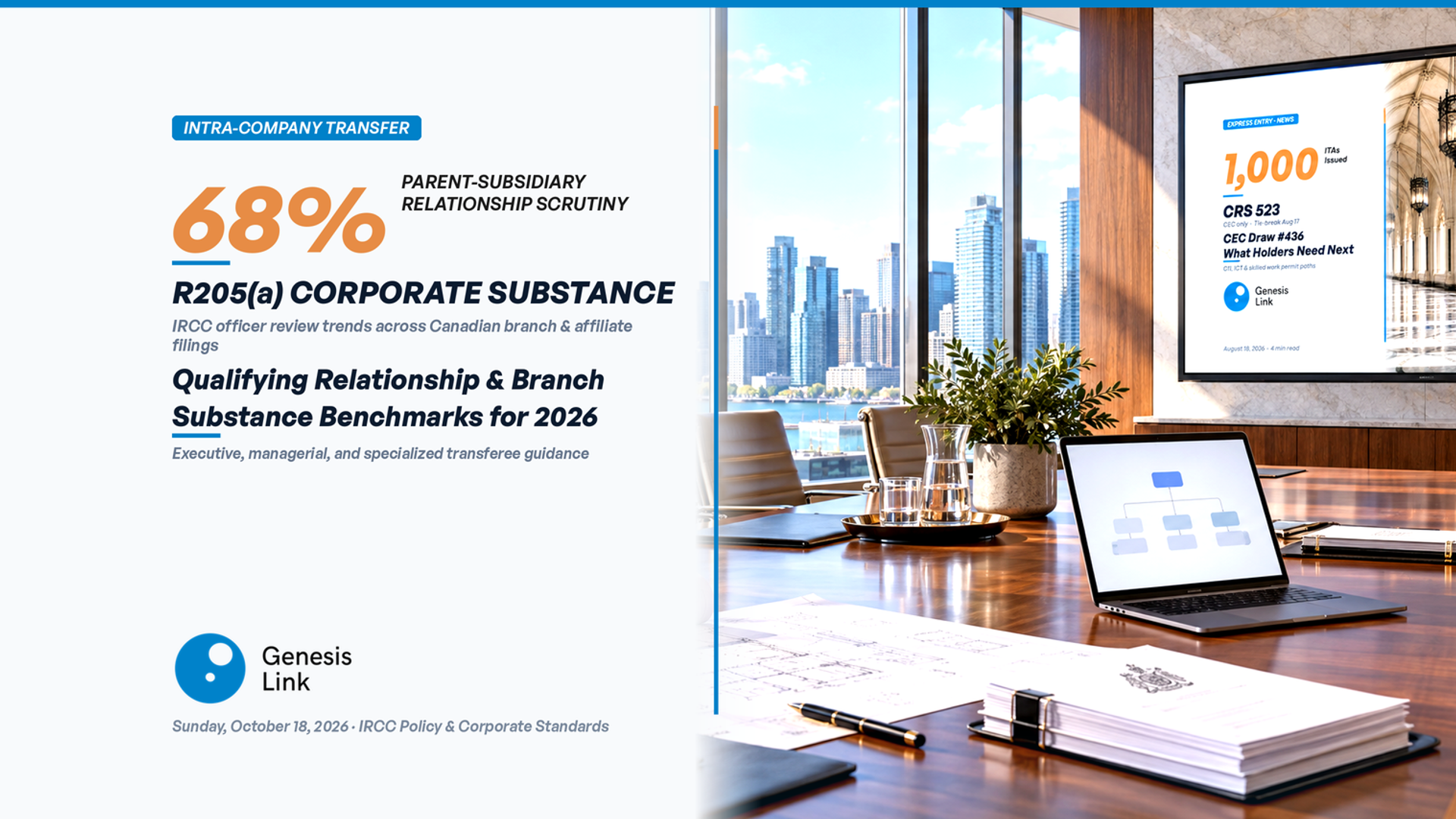
- Qualifying Relationship Priority: File analysis across corporate Intra-Company Transfer (ICT) applications indicates that over 68% of initial IRCC procedural inquiries scrutinize the foreign parent-subsidiary relationship before examining the Canadian hiring schedule.
- Executive Remuneration Continuous Proof: The transferred executive must demonstrate sustained payroll remuneration directly from the foreign sending entity throughout the 12-month qualifying window. Intermittent dividends or third-party management fees trigger direct employment challenges.
- Unencumbered Working Capital: Foreign parents establishing new Canadian branch or subsidiary offices must demonstrate capitalization sufficient to cover initial capital expenditures and 12 months of operating expenses without reliance on immediate Canadian revenue.
- Corporate Integration: Registry incorporation filings represent merely the procedural baseline; adjudicators require tangible cross-border commercial integration, intercompany service agreements, and shared enterprise platforms.
What Defines a Qualifying Corporate Relationship Under R205(a)?
Immigration counsel and corporate advisors structuring Intra-Company Transfers (ICT) under Immigration and Refugee Protection Regulations (IRPR) section 205(a) (exemption codes C61 for executives, C62 for senior managers, and C63 for specialized knowledge transferees) frequently observe that corporate registry documentation is necessary but insufficient. An officer evaluating an ICT filing must be satisfied that a genuine, ongoing qualifying relationship exists between the foreign enterprise and the Canadian entity.
Under IRCC operational instructions, a qualifying relationship requires that the Canadian and foreign employers be the same company (branch office) or related as a parent, subsidiary, or affiliate. In corporate practice, establishing this relationship requires tracing legal and beneficial ownership through voting shares, contracts of association, or joint venture governance.
What Corporate Substance Benchmarks Do Officers Scrutinize in 2026?
As IRCC tightens compliance reviews and audits across temporary foreign worker streams, officers assess whether the Canadian entity represents a genuine commercial operation capable of sustaining its business objectives. When evaluating new office setups or established subsidiaries, four primary benchmarks distinguish defensible filings:
What Our Files Show
Across our corporate consulting engagements supporting immigration law firms, applications establishing dedicated Canadian operating accounts with liquid capitalization covering at least $150,000 to $250,000 CAD in committed parent funding encounter substantially fewer procedural delays. Where parent companies provide an executed intercompany service agreement detailing intellectual property licensing and management fee structures, adjudicators rarely challenge corporate legitimacy.
How Should Immigration Counsel Structure Executive and Management Roles?
Under National Occupational Classification (NOC) TEER 0 guidelines, transferees under C61 (Executive) or C62 (Senior Manager) must primarily direct the management of the organisation or supervise a subordinate tier of managers, professionals, or supervisors. A recurring ground for refusal occurs when the submitted business plan portrays an executive transferee as the sole employee performing day-to-day administrative or sales production.
For new office extensions, IRCC guidelines recognize that an executive will initially oversee setup activities; however, the business plan must articulate a realistic organizational staffing plan demonstrating that within the initial 12-month period, Canadian hires will assume operational execution, freeing the transferee to function in an authentic executive capacity.
Frequently Asked Questions for Corporate Immigration Counsel
1. Can an ICT work permit be issued if the foreign sending enterprise is a holding company?
Yes, provided the corporate structure clearly documents that the foreign holding entity maintains effective legal and operational control over both the foreign operating entities and the Canadian subsidiary. Clear organizational charts supported by share registers and corporate resolutions must substantiate the chain of ownership.
2. Is an LMIA required for Intra-Company Transferees?
No. Intra-Company Transfers operate under LMIA exemption codes C61, C62, and C63 pursuant to section 205(a) of the Immigration and Refugee Protection Regulations. The employer must submit an Offer of Employment through the IRCC Employer Portal and pay the $230 compliance fee.
3. What initial validity period does IRCC grant for a new office ICT?
Transferees establishing a new Canadian office are typically issued an initial work permit valid for a maximum of one year. To secure an extension, the applicant must demonstrate that the Canadian business has secured physical premises, commenced commercial operations, and hired Canadian citizens or permanent residents as outlined in the initial plan.
4. Does an applicant require personal equity in the Canadian enterprise?
No. ICT transferees are employees of the multinational organisation. While executives may hold equity in the parent entity, personal equity in the Canadian subsidiary is not required. When an entrepreneur owns 100% of an independent Canadian business without a foreign qualifying parent, the C11 Significant Benefit pathway is typically the appropriate vehicle.
5. Can specialized knowledge transferees (C63) be transferred to a new office?
While legally permissible under R205(a), IRCC policy guidelines note that new office transfers for specialized knowledge staff face heightened scrutiny. Counsel must demonstrate that the enterprise has established operational management in Canada capable of directing the specialized employee.
GenesisLink collaborates directly with Canadian immigration lawyers and Regulated Canadian Immigration Consultants (RCICs) as a dedicated business consulting and corporate documentation partner. We prepare immigration-grade corporate business plans, organizational models, and market feasibility frameworks that substantiate corporate substance.
Recent News

 October 18, 2026

More on Federal work permits
 NewsExpress Entry French Draw #450: 5,000 ITAs Issued as Cut-Off Reaches 435
 NewsBDC Small Business Week 2026: 78% of Canadian SMEs Pivot to Growth Amid High-Speed Market Shifts
 NewsIRCC Overhauls Express Entry: LMIA Eliminated for Job Offers as High-Wage Points Launch
 NewsIRCC Announces Imminent Express Entry Changes: Minister Briefing Scheduled for October 16
 NewsCanada Introduces Productivity Mega Deduction: 100% Immediate Expensing for Business Investments
Discussion
Be the first to comment.
Add a comment