


Express Entry Transport Occupations Draw August 7 2026: 300 ITAs at CRS 470
IRCC held Express Entry round #434 on August 7, 2026: Transport Occupations, 2026-Version 2, 300 invitations, CRS 470. Fourth EE round in four days; business-file implications for C11, ICT and PNP holders.
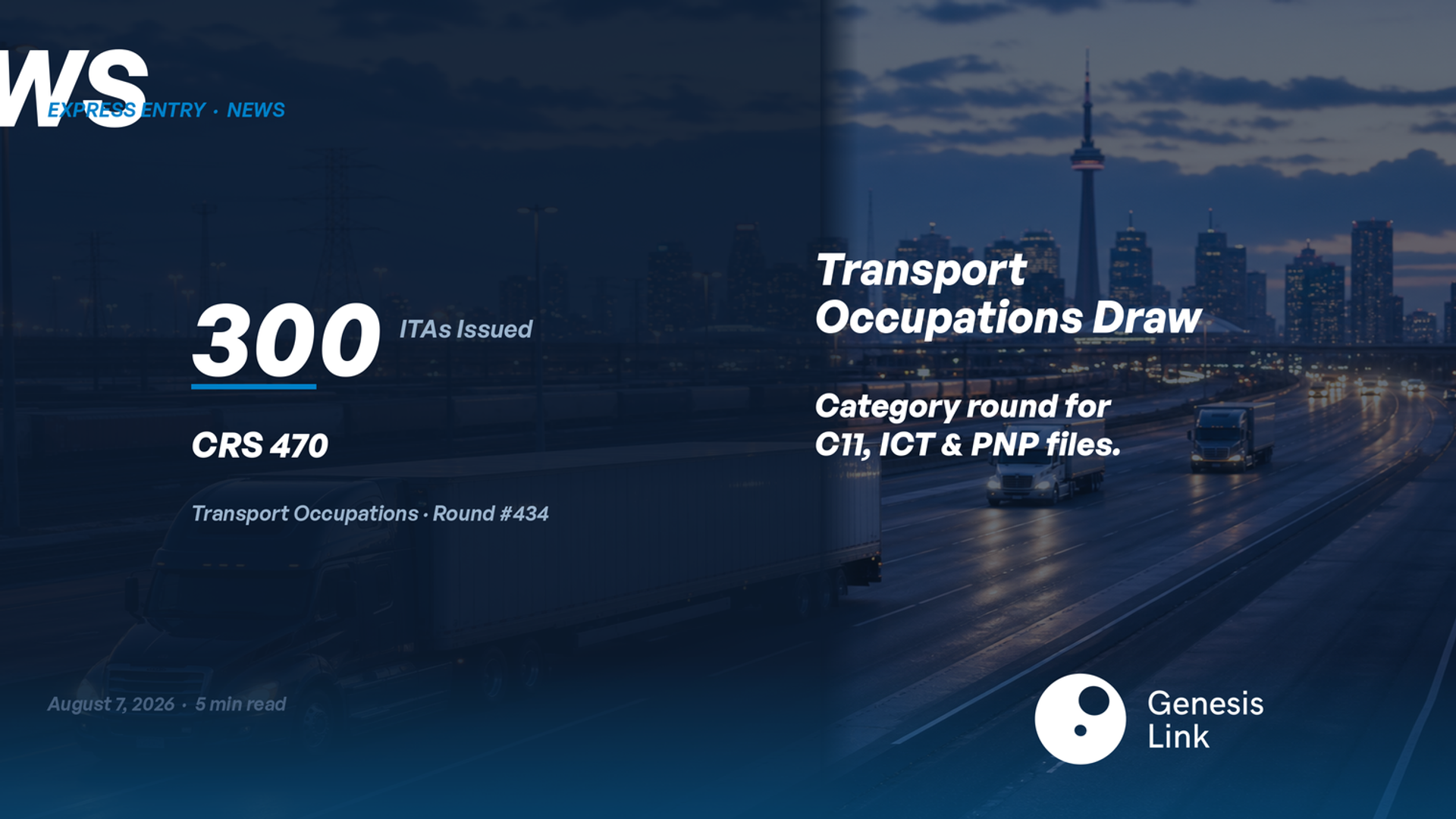
Effective August 7, 2026 at 10:08:20 UTC, Immigration, Refugees and Citizenship Canada (IRCC) ran Express Entry round #434 under the category Transport Occupations, 2026-Version 2. The department issued 300 invitations to apply (ITAs) with a Comprehensive Ranking System (CRS) cut-off of 470. The rank needed was 300 or above. The tie-breaking rule was October 11, 2025 at 14:55:49 UTC.
Primary source: IRCC Rounds of invitations and the Ministerial Instructions table.
What the numbers show
Round #434 is a category-based selection round, not a general or program-specific draw. It sits inside a dense August window:
- August 4, PNP-only, 507 ITAs, CRS 768 (#431)
- August 5, Canadian Experience Class, 3,000 ITAs, CRS 516 (#432)
- August 6, French-language proficiency, 5,000 ITAs, CRS 391 (#433)
- August 7, Transport Occupations, 300 ITAs, CRS 470 (#434)
Four rounds in four calendar days is an unusually tight sequence. For business immigration files, the pattern matters more than any single cut-off: IRCC is still running category and program lanes in parallel while provincial entrepreneur capacity stays tight.
Pool snapshot as of August 3, 2026 (published with the rounds page): total 229,100 profiles. Band 501-600 held 19,705 candidates; 451-500 held 73,099. A CRS 470 Transport cut sits inside a crowded mid-band, which is why category eligibility (not only raw CRS) decides who clears this lane.
Business immigration angle
Transport category rounds do not replace entrepreneur pathways. They do change the timing conversation for founders and executives who already hold Canadian work authorization and are building toward permanent residence.
In GenesisLink’s file work, transport-adjacent operators (logistics, fleet services, specialized equipment, supply-chain software with Canadian delivery footprints) often sit in one of three documentation stacks:
Discussion
Be the first to comment.
Add a comment