


Express Entry French-Language Draw July 22 2026: 5,000 ITAs at CRS 399
IRCC issued 5,000 invitations at CRS 399 in a French-language proficiency category-based Express Entry round on July 22, 2026. Here is what the draw means for C11, ICT, and PNP business immigration files.
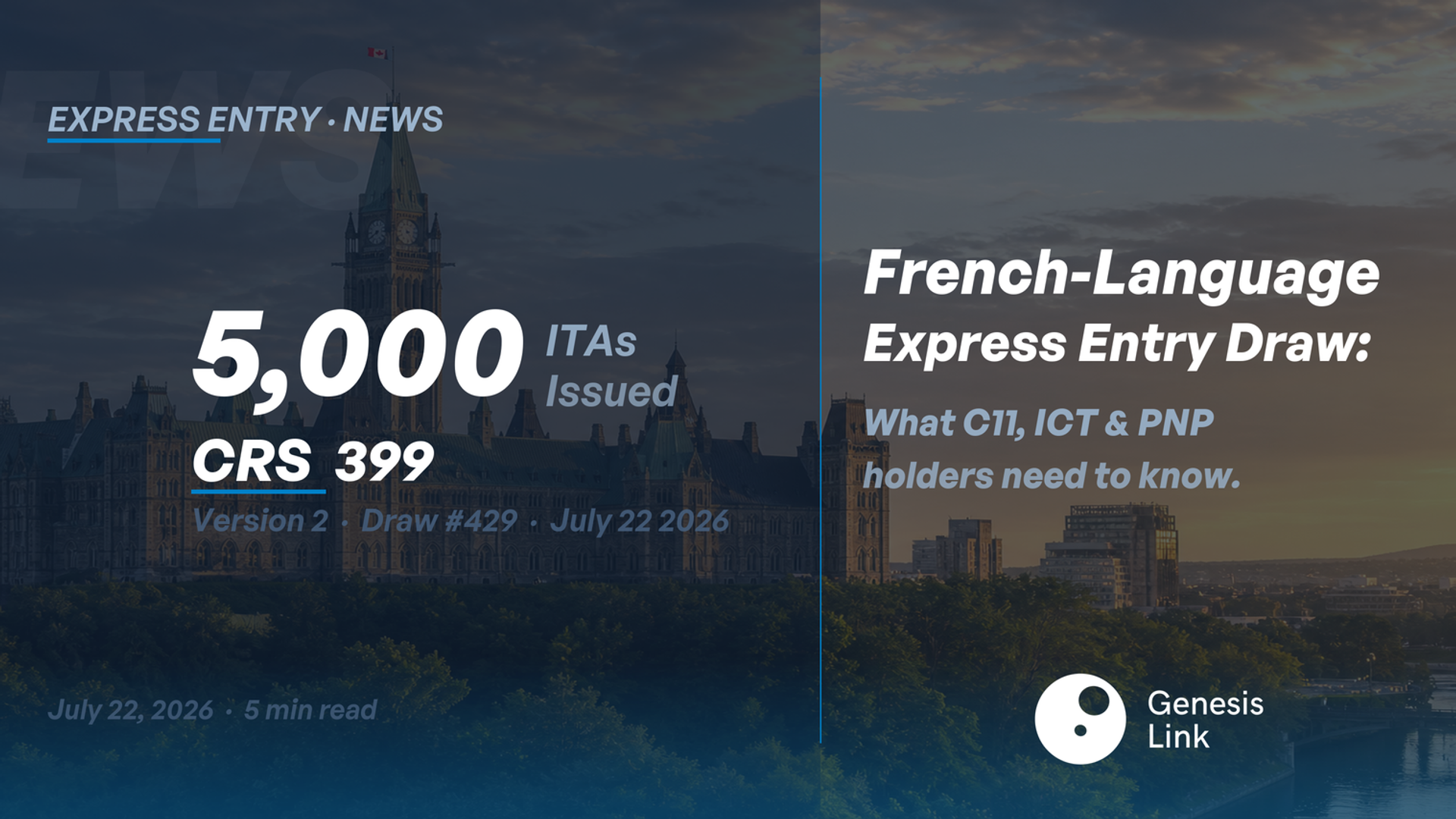
July 22, 2026. Immigration, Refugees and Citizenship Canada (IRCC) ran a category-based Express Entry round this morning under the French-language proficiency stream. According to the official Rounds of invitations page, the round took place at 11:12:26 UTC on July 22, 2026, issued 5,000 invitations to apply (ITAs), and set the Comprehensive Ranking System (CRS) cut-off at 399.
The round is labelled French-Language proficiency 2026-Version 2. The tie-breaking rule used was November 19, 2025 at 21:21:56 UTC. Ministerial Instructions for the round are posted on canada.ca (invitation query reference 429).
What the numbers show
Five thousand ITAs at CRS 399 is a large category-based pull relative to the program-specific rounds earlier this week. For context on the same pool snapshot IRCC published as of July 19, 2026:
- Total candidates in the pool: 231,533
- CRS 501. 600: 18,133
- CRS 601. 1200: 511
- CRS 351. 400: 51,107
A cut-off of 399 sits near the top of the 351. 400 band. That means a large share of French-proficient candidates in the mid-300s to high-300s CRS range were pulled in a single round. Category-based selection does not require a provincial nomination; it ranks eligible candidates who meet the French-language category criteria among the three Express Entry programs (Federal Skilled Worker, Canadian Experience Class, and Federal Skilled Trades where applicable).
This follows two program-specific rounds earlier in the week: a Provincial Nominee Program round on July 20 (511 ITAs, CRS 744) and a Canadian Experience Class round on July 21 (2,000 ITAs, CRS 516). The French round is the third Express Entry activity in three days and the first large category-based pull of this stretch.
Why this matters for business immigration files
GenesisLink does not provide immigration advice. We work the business side of files that sit beside Express Entry pathways. C11 significant benefit work permits, ICT intra-company transfers, and provincial entrepreneur streams that later connect to PR. French-language category rounds change the planning conversation in three practical ways.
1. Language as a deliberate file design input. For founder and executive candidates who already hold (or are building) Canadian work experience under C11 or ICT, French proficiency is no longer only a soft skill on a CV. When IRCC runs multi-thousand ITA French rounds at sub-400 CRS, the business plan and work-permit timeline should account for when language testing and documentation will be ready. Not as an afterthought after the work permit is issued.
2. Pool competition signal for CEC-bound C11/ICT holders. Yesterday's CEC round cut at CRS 516 with 2,000 ITAs. Today's French round cut at 399 with 5,000 ITAs. Candidates who can qualify under both CEC and the French category face a different invitation probability than CEC-only profiles. Business documentation that supports continuous, well-evidenced Canadian work experience still matters; language category eligibility can change which round type is realistic first.
3. Provincial entrepreneur files and bilingual markets. PNP entrepreneur candidates targeting bilingual or francophone markets (parts of Ontario, New Brunswick, Manitoba, and Quebec-adjacent corridors) should treat French-category Express Entry activity as a parallel planning track, not a substitute for provincial performance agreements. Nomination still drives PNP-specific rounds (see July 20's CRS 744 PNP cut-off). French category rounds reward language readiness in the federal pool after, or alongside, provincial processes.
What our files show
Across more than 300 business immigration files from 30+ countries, we regularly see language planning lag the business case. The business plan, financial model, and job-creation logic are built carefully; TEF/TCF or IELTS/CELPIP timing is left open. In files where founders intended a C11-to-CEC or C11-to-FSW path, the ones that moved cleanly into competitive CRS bands had language testing scheduled in the first 90 days of Canadian operations, not in year two. A 5,000-ITA French round at CRS 399 rewards that sequencing. It does not replace the need for a defensible significant-benefit or ICT business case. It multiplies the value of one that is already clean.
We also see a pattern in owner-operator and executive files: French-proficient founders from North Africa, Europe, and parts of the Middle East often under-document the business side because they assume language alone will carry the PR file. Category-based rounds invite applications; they do not approve them. Incomplete employment letters, weak job descriptions, or business plans that do not match the NOC claimed still break files after the ITA.
What practitioners should do this week
- Confirm category eligibility against IRCC's current French-language proficiency category criteria before advising clients that this round “would have caught them.” Category rules are defined in the ministerial instructions for category-based selection, not only by a CRS number.
- Reconcile language timelines with work-permit timelines. For active C11 and ICT files, map when language results will be available relative to permit start dates and first-year operational milestones.
- Do not treat CRS 399 as a general-pool signal. This cut-off applies inside the French-language category ranking. General and program-specific rounds this week sat far higher (PNP 744, CEC 516).
- Keep business evidence ITA-ready. Invitation volume creates a surge of applications. Files with thin employment or business documentation face the same refusal risk as always. Only faster.
Primary source
All draw figures in this piece are taken from IRCC's official Express Entry rounds page:
Latest round listed: French-Language proficiency 2026-Version 2. July 22, 2026 at 11:12:26 UTC. 5,000 invitations. CRS 399.
This is a developing story. Check the canada.ca rounds page for any subsequent corrections or additional rounds.
Related reading
For how Express Entry pool composition sat before this round, see our Express Entry Pool Snapshot – July 19, 2026. For C11 holders building toward CEC eligibility, see C11–CEC Work Experience Documentation Gap 2026.
GenesisLink is a Canadian business consulting firm. We support immigration professionals and entrepreneurs on the business side of C11, ICT, and PNP entrepreneur files. Business plans, financial models, job-creation logic, and documentation systems. We do not provide immigration legal advice or representation before IRCC.
To discuss how language-category Express Entry activity intersects with an active business immigration file, book a working session or start with our business immigration assessment.
Author: Sajad Bahramian Offices: Ottawa (1000 Innovation Drive, Kanata) · Vancouver (777 Dunsmuir St, 17th Floor)
Recent News

 October 21, 2026

More on Federal work permits
 NewsExpress Entry CEC Draw 439 Confirmed: 2,000 ITAs at CRS 521-1 September 2026
 NewsBusiness Immigration Policy Watch August 21 2026, Capacity Before Capital
 NewsExpress Entry French Draw #437, August 19, 2026: 5,000 ITAs at CRS 382
 NewsExpress Entry 2027 Category Consultation, What Business Immigration Files Need by September 1, 2026
 NewsBusiness Immigration Policy Watch August 6, 2026: The 48-Hour Post-Draw Window for C11, ICT and PNP Files
Discussion
Be the first to comment.
Add a comment