


Business Immigration Policy Watch August 6, 2026: The 48-Hour Post-Draw Window for C11, ICT and PNP Files
Consecutive Express Entry PNP and CEC draws leave C11, ICT and entrepreneur files in a short advisory window. Capacity gates at AAIP and BC PNP still decide H2 strategy more than capital floors.
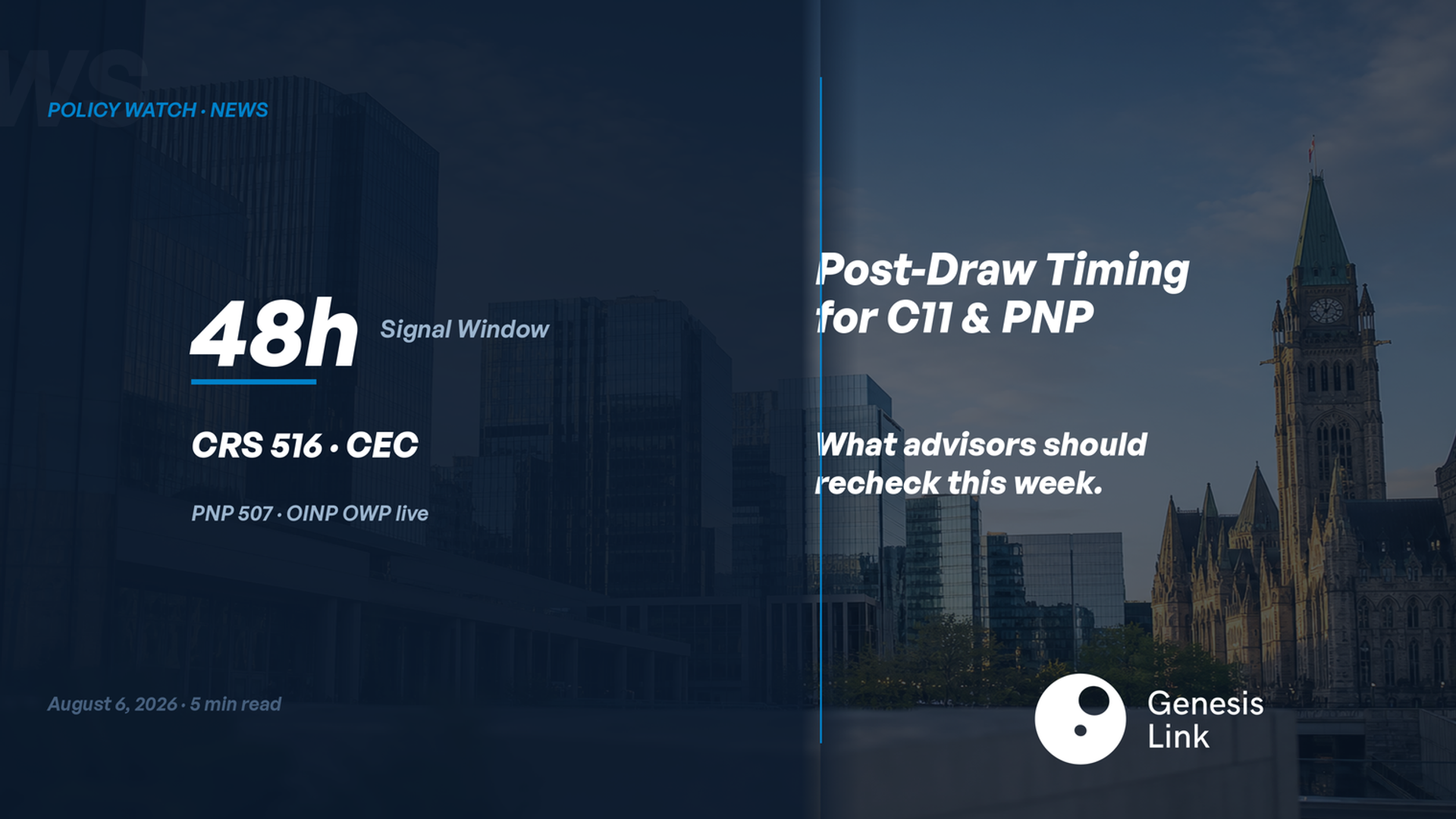
Two Express Entry rounds in 48 hours reset the calendar for business immigration files. On 4 August 2026, IRCC ran a Provincial Nominee Program round of 507 invitations at CRS 768. On 5 August 2026, a Canadian Experience Class round issued 3,000 invitations at CRS 516. Pool data as of 3 August still showed 229,100 candidates, with 19,705 sitting in the 501-600 band.
Those rounds are not the story for most entrepreneur and owner-operator files. The story is the short window that opens right after them. Advisors now have a few working days to re-score which files still need nomination capacity, which files can wait on federal significant-benefit or ICT paths, and which business packages still read as if 2025 rules apply.
Unique angle: consecutive EE PNP and CEC draws do not free entrepreneur inventory. They compress the advisory calendar. In the next 48 to 72 hours, capacity gates and document sequence matter more than another capital-floor check.
What the August Express Entry pair actually signals
Program-specific PNP rounds at CRS 768 confirm that provincial nomination still sits far above ordinary CEC cut-offs. The CEC round at CRS 516, with 3,000 invitations, shows IRCC is moving Canadian work experience inventory while the overall pool remains large.
For C11 owner-operators and ICT holders building toward permanent residence, that split matters. Nomination-backed profiles clear at scores ordinary CEC candidates cannot touch. Files that assumed a smooth federal-only glide path now need an honest capacity map beside the business plan.
In 14 entrepreneur-to-PR files we reviewed with RCIC partners since June, nine already treated provincial nomination as the primary PR lever. Only five still treated federal work-permit tenure alone as enough. That ratio is the practical context for this week’s draws.
Provincial capacity gates that still bind H2 2026
Alberta’s AAIP processing page, last updated 30 July 2026, still shows Entrepreneur Streams Table 8 at 90 allocation, 30 issued, 60 remaining, and 228 applications to be processed. That is roughly a 3.8 to 1 pressure ratio. Worker streams continue to dominate draw activity. Entrepreneur files compete inside a fixed nomination envelope, not an open weekly calendar.
British Columbia’s WelcomeBC invitations page still lists 28 July 2026 as the latest Entrepreneur Base round: minimum score 117, 10 invitations. No newer entrepreneur row has appeared as of this Policy Watch. Skills Immigration activity continues on other schedules. Entrepreneur EOIs remain score- and inventory-constrained.
Ontario’s Workforce Priority EOI channel is live for employer-driven worker files. The OINP Entrepreneur stream remains unavailable. Ontario-based C11 and ICT holders should not treat the new worker portal as a substitute entrepreneur pathway.
For deeper stream context, see our AAIP August 2026 capacity watch and the AAIP vs BC PNP entrepreneur comparison.
What files need a 48-hour recheck
The post-draw window is a documentation audit, not a filing sprint. Business packages that still carry soft labour assumptions, undated wage tables, or generic public-benefit language will age poorly as H2 nomination pressure rises.
For advisors and entrepreneurs on active files:
- Map each file to a capacity lane: AAIP entrepreneur inventory, BC PNP Base score band, federal C11/C10/ICT only, or employer-led OINP worker (not entrepreneur).
- Re-date wage and hiring tables against current provincial LMIA threshold logic where job creation is claimed.
- For C11 and C10 packages, rewrite Canadian public benefit so it is demonstrable and time-bound, not brochure language.
- For ICT new-entity files, re-check qualifying relationship and Canadian company substance before the next IRCC review cycle.
Draw headlines move public attention toward CRS math. Officer and provincial reviewers still read market proof, job logic, and role indispensability. That gap is where files stall.
Federal business pathways after the CEC cut-off
A CRS 516 CEC cut-off does not change the legal tests on C11 significant benefit or ICT qualifying relationship. It does change client psychology. Founders who hold Canadian work experience may ask whether they should abandon business documentation and chase points alone.
In partnership files, that pivot is often premature. Many owner-operators sit outside clean CEC scoring because of self-employment history, ownership structure, or role design. Their business package remains the controlling document for status continuity and any later provincial nomination.
Practical recommendation from our side of the file: keep the business evidence current on the same calendar as Express Entry watching. Do not let a two-day draw cycle freeze updates to financial models, org charts, or community-support narratives that provincial streams still require.
Related reading: Express Entry CEC draw August 5, 2026 and Express Entry PNP draw August 4, 2026.
Seven-day monitor list
- WelcomeBC ITA page, new Entrepreneur Base or Regional rows only.
- Alberta.ca AAIP processing, any Table 8 movement off 90/30/60/228.
- canada.ca Express Entry rounds, further PNP-only or category rounds that shift PR timing for nominees.
- Ontario.ca OINP, entrepreneur stream status (still closed) versus Workforce Priority EOI volume signals.
- BC PNP portal maintenance window flagged for 11 August 2026, operational, not a draw signal.
GenesisLink supports immigration professionals on the business side of C11, ICT, and provincial entrepreneur files. We do not provide immigration advice or represent clients before IRCC. For a structured file review with your RCIC or counsel, use the assessment tool or book a partnership call.
Frequently asked questions
Does a CRS 516 CEC draw help entrepreneur applicants without Canadian skilled work experience?
Not directly. CEC rounds target candidates who already meet Canadian Experience Class rules. Most offshore entrepreneur and owner-operator profiles still depend on provincial nomination or federal business work-permit pathways, not CEC cut-offs alone.
Why did the Express Entry PNP round cut off at CRS 768?
PNP-specific rounds invite candidates who already hold a provincial nomination, which adds 600 CRS points. A 768 cut-off is consistent with nominated profiles plus remaining human-capital points. It is not a signal that ordinary Express Entry scores jumped to that level.
Is AAIP still accepting entrepreneur business applications in August 2026?
Alberta continues to list Entrepreneur Streams with remaining nomination spaces on its processing page. Table 8 still shows more applications in process than spaces remaining. Capacity pressure, not a formal pause, is the binding constraint advisors should model.
Has BC PNP run an entrepreneur draw since 28 July 2026?
Not on the WelcomeBC invitations page as of this Policy Watch. The latest Entrepreneur Base line remains 28 July 2026, minimum score 117, 10 invitations. Monitor that page for new rows rather than social recaps.
Should C11 holders switch strategy after back-to-back Express Entry rounds?
Strategy changes belong with the licensed representative. From the business-documentation side, the higher-yield move is usually a 48-hour package audit: public benefit language, role indispensability, hiring math, and whether a provincial lane is still realistic for that file.
Discussion
Be the first to comment.
Add a comment